

How To Use the Value Finders: A Complete Guide
December 3, 2025
Part of the Mama Knows Bets Education Series. See also: What is +EV Betting?, Bankroll Basics, Why Taking the Best Odds Matters, and [The Seven Deadly Sins of Betting - COMING SOON!].
See Also:How to Use the Value Finders Results Dashboard for how to view and interpret results from the Value Finders!*
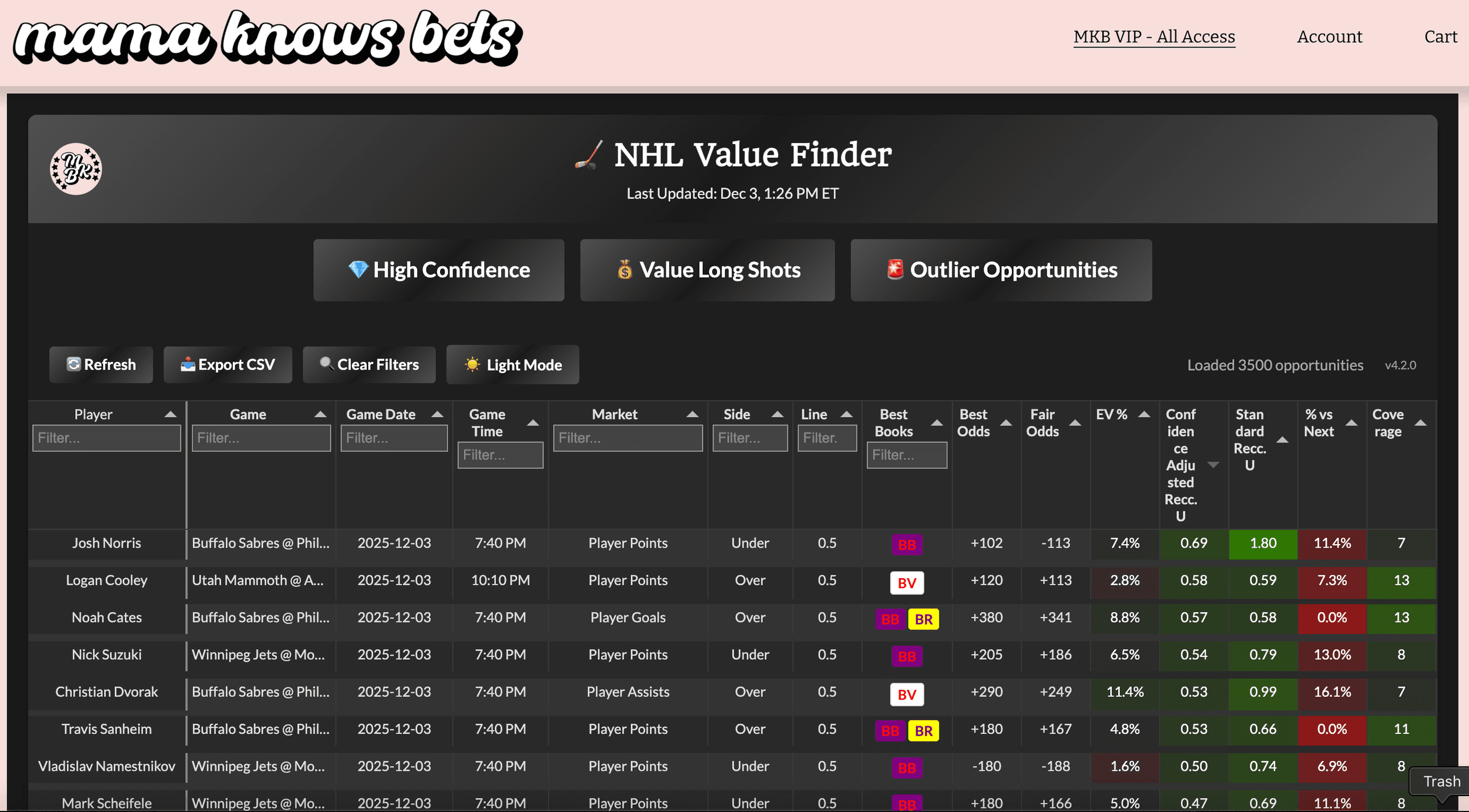
What is the Value Finder?
The Value Finder is your tool for identifying +EV (positive expected value) betting opportunities. It scans odds across multiple sportsbooks, calculates fair value based on sharp book consensus, and surfaces bets where you're getting better odds than the true probability suggests.
In simple terms: it finds bets where the math is on your side.
The Basics
-
Each sport has its own Value Finder: NHL, NFL, NBA, Golf are currently live with the V2 Value Finder! MLB and WNBA will launch when each season begins. Other sports will potentially be added over time!
-
All Value Finders update every ~20 minutes during the day (5am-10pm EST), and hourly overnight (10pm-5am EST) when there are lines available for upcoming games
-
Easy links to the Value Finders live on the MKB VIP Homepage (bookmark this!), and there are also links to each Value Finder included with each update pinged in the Discord #value-finders channel
Understanding the Columns
Let's break down each column so you know exactly what you're looking at.
Player, Game & Bet Info
The Value Metrics (The Important Stuff)
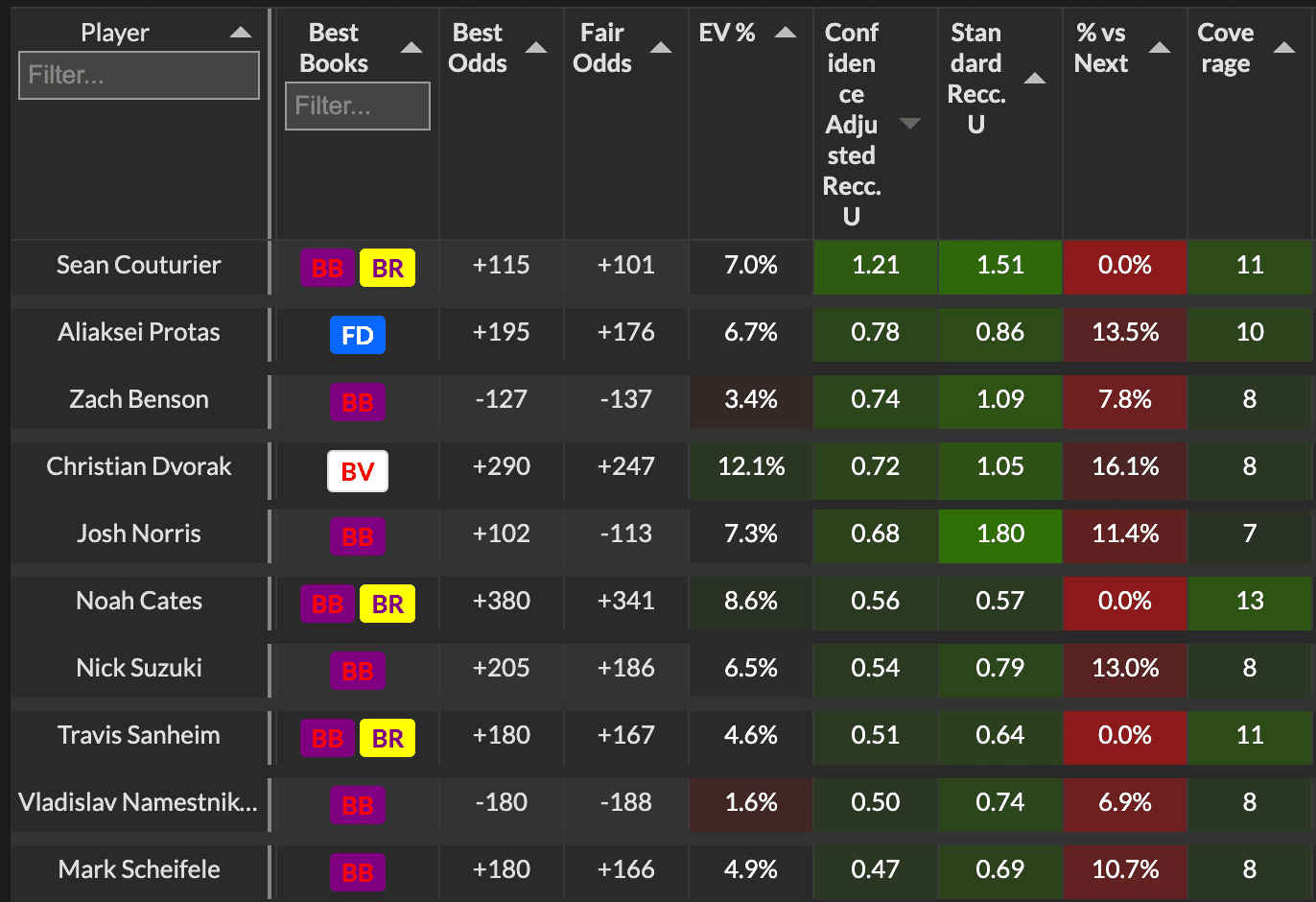
These are the columns that tell you HOW MUCH value exists in the bet.
-
Best Book - The sportsbook(s) offering the best odds for this bet
- This is where you should place your bet to maximize value - the Best Book has the highest odds available across all books we track. If multiple books are tied, they will all appear here.
-
Best Odds - The American odds at that book (e.g., +360)
-
Fair Odds - Our calculated "true" odds based on sharp book consensus → Read How the Value Finder Calculates Fair Value below to see how we came to this number!
-
EV % - Expected Value percentage - how much edge you have **Deep Dive Below!
-
Confidence Recc. U - Recommended bet size adjusted for market confidence **Deep Dive Below!
-
Standard Recc. U - Recommended bet size using straight Kelly calculation **Deep Dive Below!
-
% vs Next - How much better the best book is vs the next best option **Deep Dive Below!
-
Coverage - How many books are offering odds on this market
-
Higher coverage = more confidence in the Fair Value calculation. I personally prefer lines with most/all books reporting odds
-
If coverage is low (2-3 books), be more skeptical of the opportunity - the Fair Value may be less reliable
-
Impacts Confidence Adjusted Recc. U - learn more in Deep Dive below!
-
Deep Dive: Understanding EV %
EV % (Expected Value Percentage) tells you your mathematical edge on a bet.
-
EV 5% means for every $100 you bet long-term, you expect to profit $5
-
EV 10% means for every $100 you bet, you expect to profit $10
-
Higher EV = bigger edge
This is calculated by comparing the odds you're getting (Best Odds) to the Fair Odds. If Fair Odds are +300 and you're getting +360, you have positive EV because you're being paid more than the true probability suggests.
More in +EV Betting Basics below, and even MORE in our post on What is +EV Betting?
Deep Dive: Confidence Recc. U vs Standard Recc. U
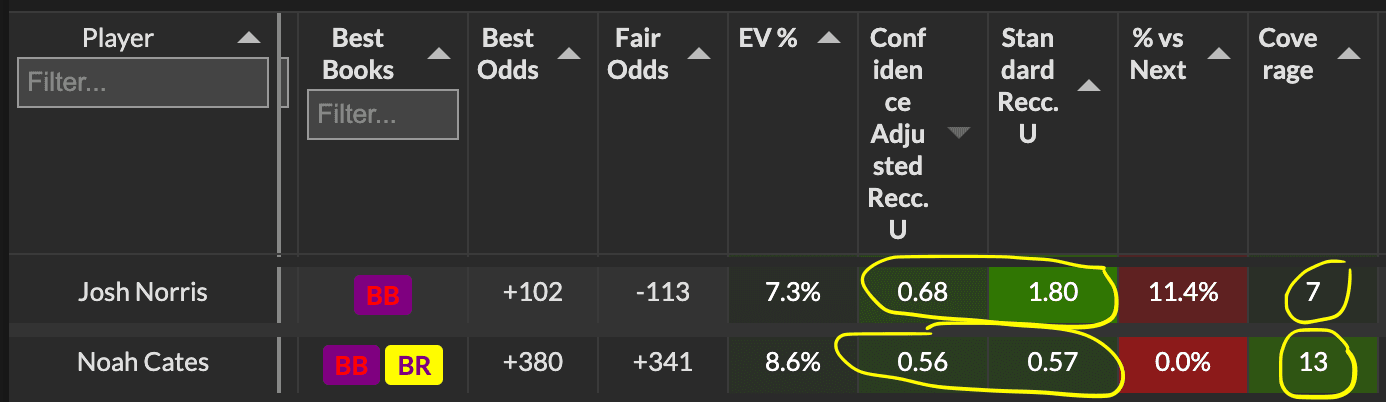
This is one of the most important distinctions to understand.
Standard Recc. U is what you'd get if you plugged the Best Book odds and Fair Value odds into a quarter Kelly calculator. It's the "pure math" recommendation.
Confidence Recc. U takes that Standard recommendation and scales it down based on how confident we are in the Fair Value calculation.
Here's why this matters:
The Fair Value odds are calculated based on which books are reporting odds for that market. If we have odds from Pinnacle, FanDuel, DraftKings, BetMGM, and 10 other books - we're very confident in that Fair Value. If we only have odds from 2-3 soft books? We're less confident.
Confidence Recc. U will always be LESS THAN or EQUAL TO Standard Recc. U.
This builds in a buffer. If only a few soft books are reporting, we don't get overly excited by seeing one as an outlier - because we don't trust those books as much to forecast event probability accurately.
My recommendation: Sort by Confidence Recc. U. It's the more conservative, safer metric that accounts for market uncertainty.
For more about setting and managing your bankroll to determine what your unit should be and therefore how much to wager per bet, please read our Bankroll Basics article!
Deep Dive: % vs Next Book
This column highlights potential outliers and mispricings in the market.
% vs Next shows how much better the Best Book's odds are compared to the next closest book. The higher this number, the more that Best Book is an outlier compared to the rest of the market.
-
% vs Next = 0-10% - Normal spread, multiple books are close
-
% vs Next = 30%+ - The Best Book is significantly out of line with everyone else
-
% vs Next = 50%+ - Major outlier, potentially a mis-priced line
Why this matters:
When a book is way out of line with the rest of the market, it could mean:
-
They haven't adjusted their line yet (opportunity!)
-
They have different information (less likely)
-
It's a pricing error (rare but happens)
High % vs Next opportunities are often the juiciest - you're catching a book that's mispriced relative to the consensus. These are the ones you want to grab quickly before they correct.
Individual Book Odds
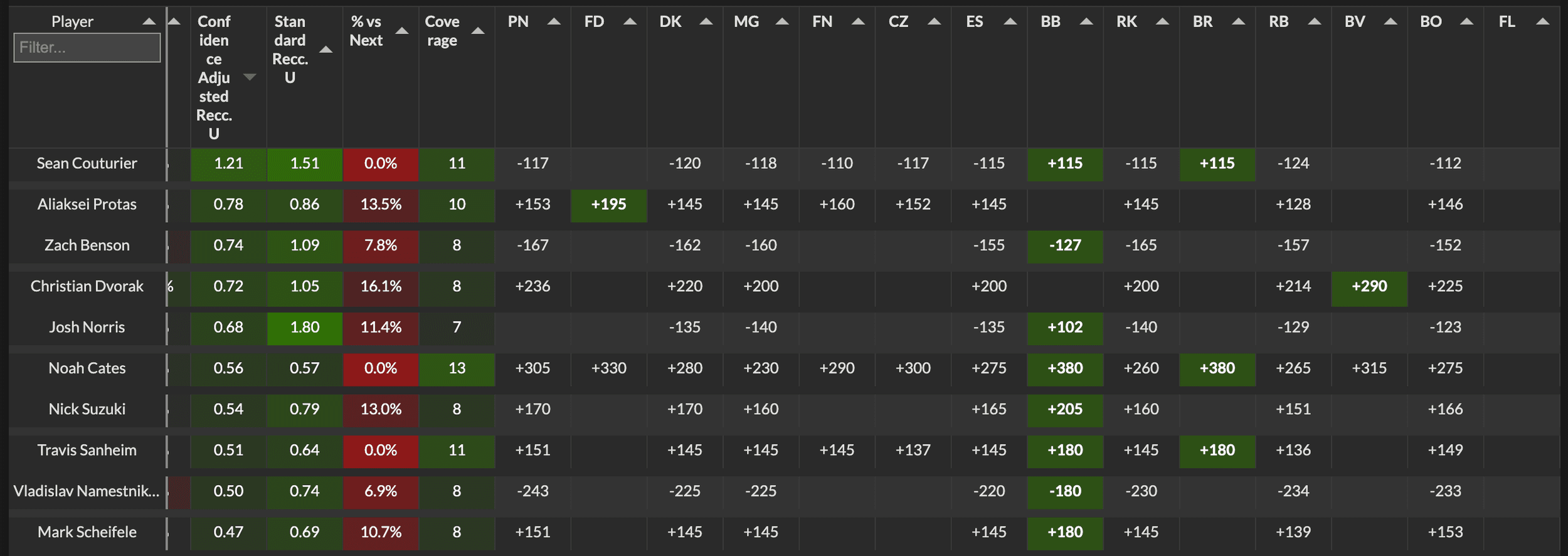
The remaining columns show the odds at each specific sportsbook:
-
PN = Pinnacle
-
FD = FanDuel
-
DK = DraftKings
-
MG = BetMGM
-
FN = Fanatics
-
CZ = Caesars
-
ES = TheScore
-
BB = BallyBet
-
BR = BetRivers
-
RK = HardRock
-
BO = BetOnline
-
RB = ReBet
-
BV = Bovada
-
FL = Fliff
-
B3 = Bet365
(Available books may vary by sport and market)
These let you see:
-
What odds are available at YOUR books
-
The spread between sharp books (Pinnacle) and soft books
-
Where the outliers are
-
Best Book(s) are highlighted in GREEN
Betslip Deep Linking
You no longer have to flip over to your sportsbook and retype a bet by hand. Betslip deep linking lets you tap an opportunity right in the Value Finder and land in your book's betslip with the selection already loaded.
Look for the ↗ arrow — it marks every spot that supports one-tap betslip linking:
-
Book odds cells — any individual book's odds with a ↗ is a live link. Tap FanDuel's price on a row and FanDuel opens with that exact bet in your betslip.
-
Best Odds column — links straight through to whichever book holds the best number.
-
Player Details → All Props — the best book badge on each prop is a deep link too, so you can research a player and bet without leaving the panel.
-
Parlay HQ — when you build a parlay, each book gets its own betslip link to load every leg at once.
Major books — DraftKings, FanDuel, BetMGM, Caesars, ESPN BET, Hard Rock, Novig and more — are supported, and the list keeps growing. It works on desktop and mobile (on mobile it opens your sportsbook app). Books without the arrow simply don't offer betslip linking.
One reminder: deep links load your selections, but odds move fast — always confirm the price and your stake in the sportsbook before placing the bet.
How to Use the Value Finder
Sorting
Click any column header to sort by that column. Click again to reverse the sort order.
My default: Sort by Confidence Recc. U, high to low. This puts the highest-confidence, highest-value opportunities at the top.
Other useful sorts:
-
EV % - See the highest mathematical edges
-
Game Time - Find opportunities for games starting soon
-
Coverage - Prioritize well-covered markets
-
% vs. Next - Look for outliers
Filtering
Use the filter row below the headers to narrow down opportunities.
Filter by Player: This is the only free-text search field. Type any part of a player's name to find them.
Filter by Book, Market, Game, etc.: These use dropdown menus. Click the dropdown and select from the available options.
Multi-Select Filtering: You can select multiple values from the same dropdown! For example:
-
Select both "DK" and "FD" in the Best Book filter to see opportunities at either book
-
Select "Points" and "Assists" in the Market filter to see both market types
Select All / Clear All: Every multi-select dropdown includes a Select All button at the top. This is useful when you want to see almost everything — click Select All, then un-check just the one or two options you don't want. Much faster than checking them one by one. The Clear All button removes all selections.
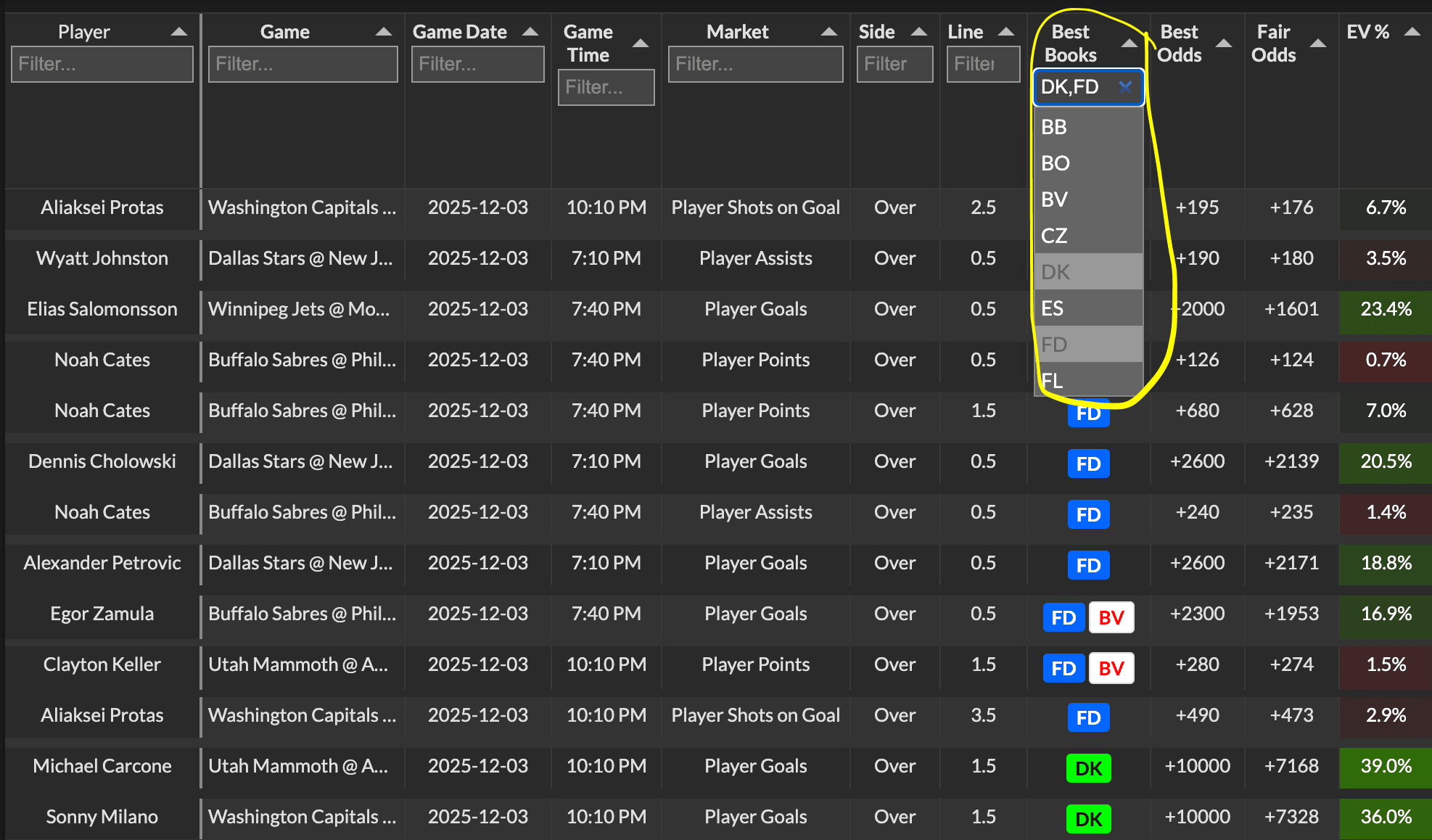
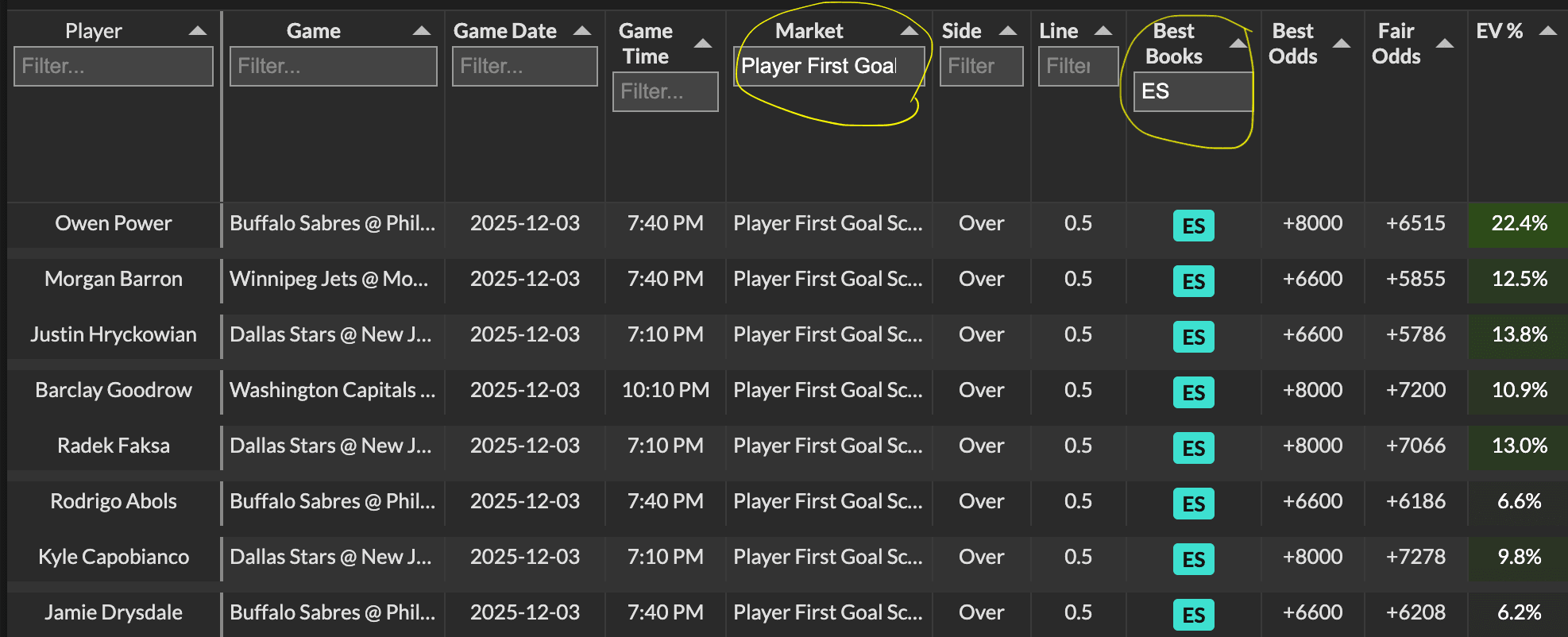
Combining Filters: Filters work together across columns. You can filter by Book AND Market AND Game simultaneously to narrow down to exactly what you're looking for.
Pre-Made Filters
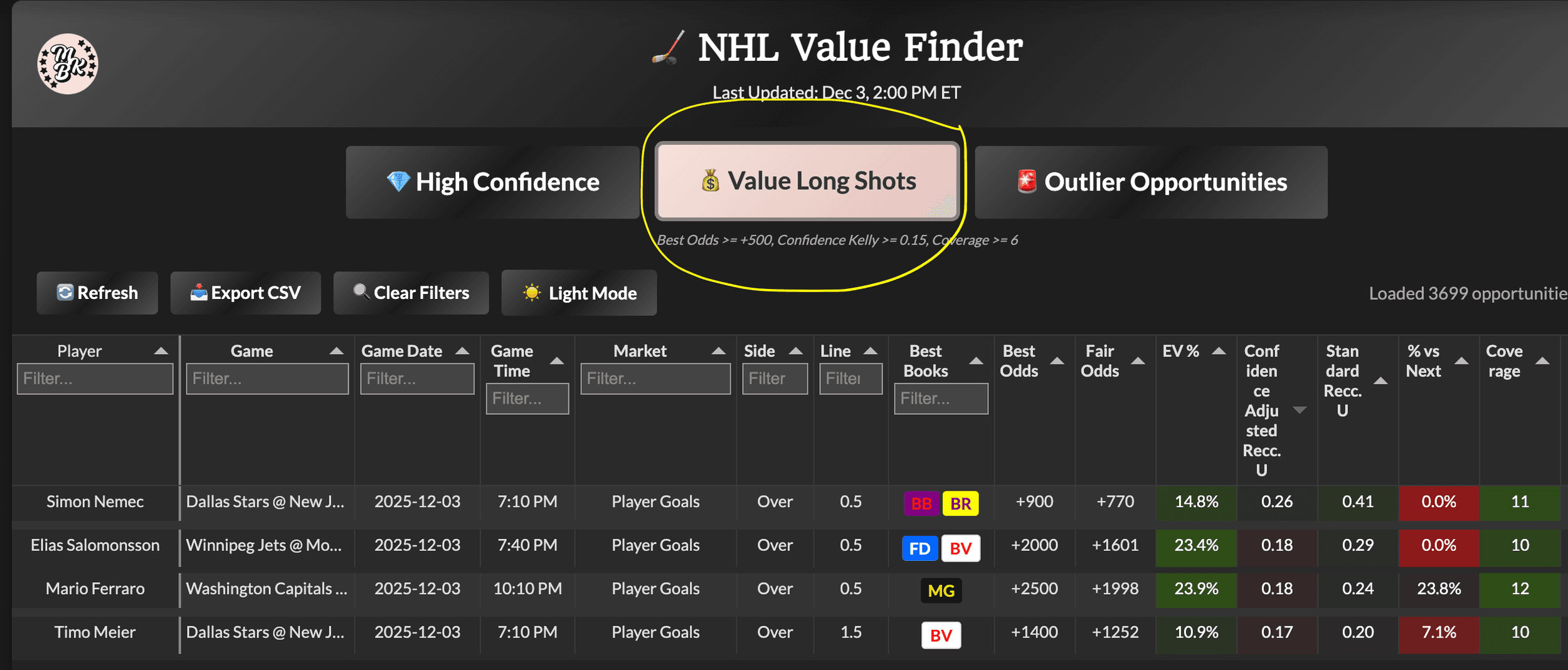
Each Value Finder has pre-made filter buttons that surface helpful cohorts of opportunities:
High Confidence
-
Shows opportunities with high Confidence Recc. U values
-
The cream of the crop - highest confidence plays where we trust the Fair Value calculation
Value Long Shots
-
Shows higher-odds opportunities (+400 and above) with solid value
-
Longshot bets that still have meaningful +EV edge
Outlier Opportunities
-
Shows bets where one book is significantly out of line with the market (high % vs Next)
-
Potentially mispriced lines you want to grab before they correct
Click a filter button to apply it. Click "Clear Filters" to reset and see all opportunities again. You can also apply any of the other filters while using a pre-made filter (for example, search for “Player Goals” within “Value Long Shots”)!
Toolbar Buttons
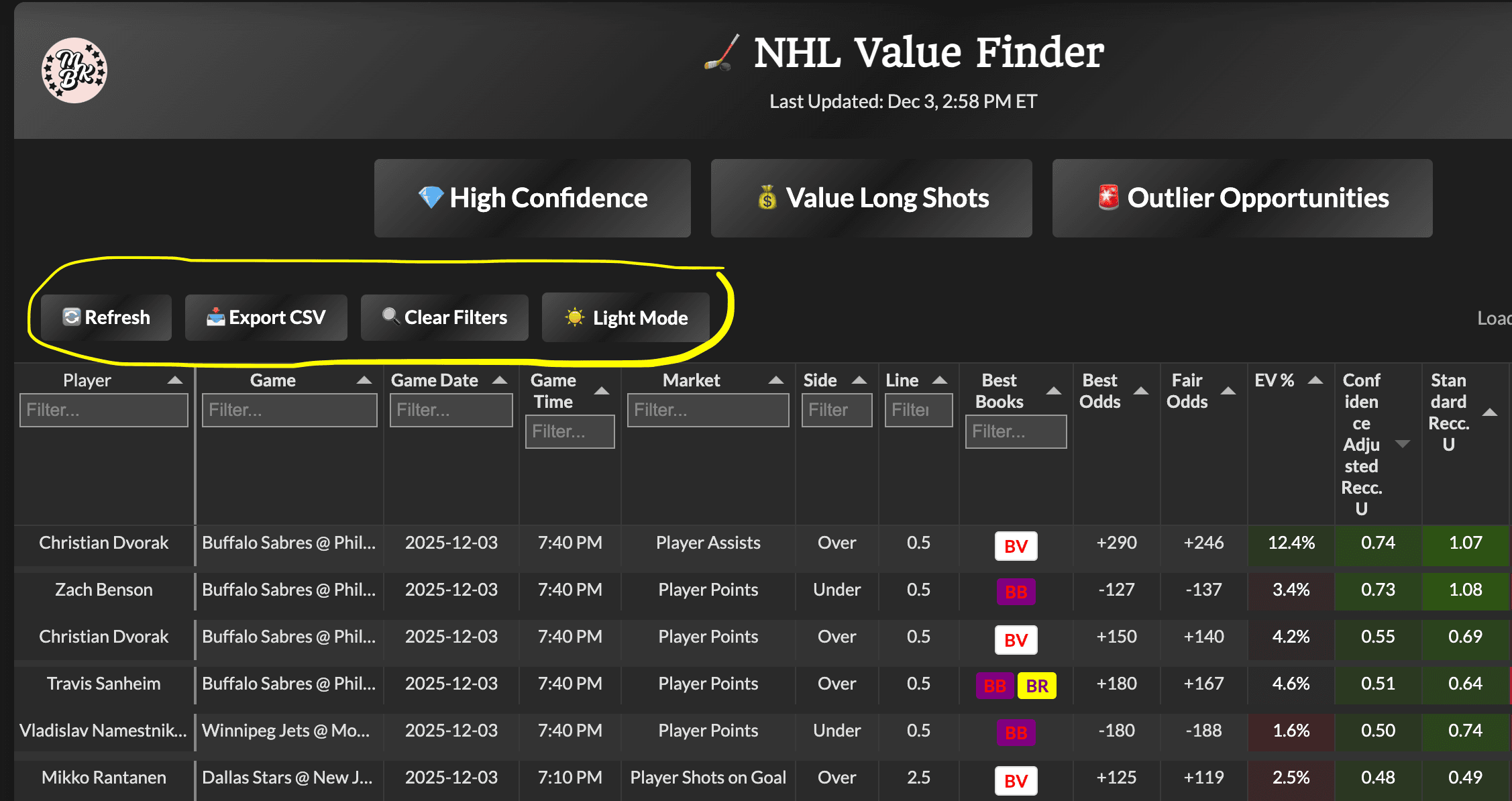
The Value Finder has a few utility buttons to help you work more efficiently:
Refresh - Pulls the latest data from the database. Use this to see new opportunities that have come in since you loaded the page. Note the Value Finder will also attempt to auto-refresh every 2 minutes, so you may notice it update without needing to hit this button!
Export - Downloads all current opportunities as a CSV file. Useful if you want to analyze opportunities in a spreadsheet, track your own records, or save a snapshot of what was available. Available on mobile as well as desktop.
Clear Filters - Resets all filters and sorting back to the default view. Quick way to start fresh if you've narrowed things down too much.
Light/Dark Mode Toggle - Switches between light and dark themes. Use whichever is easier on your eyes.
Odds Format (+/− · % · Both) - Controls how odds are displayed. +/− shows American odds (+150), % shows implied probability (40.0%), and Both stacks them with the percentage above the price. Handy now that several exchanges quote in percentages - Both lets you read a mixed board without converting in your head. The color shading on the cells is based on the underlying price either way, so it doesn't change when you switch.
One of our most powerful features is the ability to see how odds have moved - right from the Value Finder table. The chart covers a line's full history, up to a maximum of seven days, and every point shows its date and time so you always know which day you're reading. This gives you extra context on whether a line is moving in your favor or if you should act quickly before an opportunity disappears.
How to Access Sparklines
On Desktop: Simply hover your mouse over any odds value. You can hover over:
-
The Best Odds column to see overall line movement across ALL books at once
-
Any individual book column (PN, FD, DK, etc.) to see that specific book's line history
On Mobile: Tap any odds value with a dotted underline to open a sparkline popup.
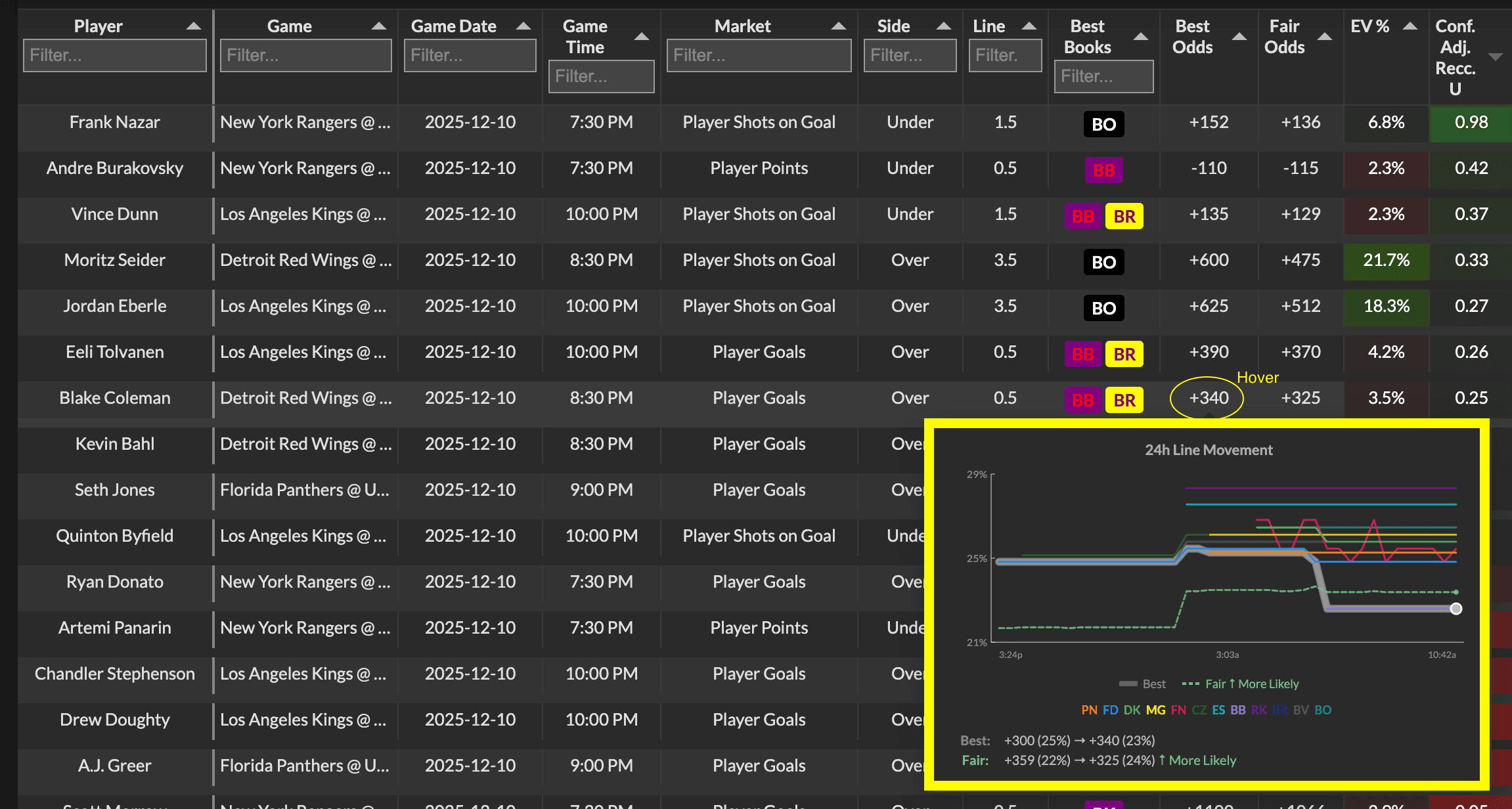
Understanding the Chart - The Basics
The sparkline shows you how lines have moved throughout the day. Here's what you're looking at:
The Vertical Axis (Y-axis) = Probability %
This is important to understand: the chart shows implied probability, not odds directly. Probability is the inverse of odds:
-
Higher probability = Lower odds (the event is more likely to happen)
-
Lower probability = Higher odds (the event is less likely to happen)
So if you see a line moving UP on the chart, that means:
-
The probability of the event is INCREASING
-
The odds are DECREASING (getting shorter)
And if a line is moving DOWN:
-
The probability of the event is DECREASING
-
The odds are INCREASING (getting longer/higher payout for you as a bettor)
The Lines on the Chart
In the Best Odds sparkline, you'll see multiple lines:
-
Gray glow line: This is the "Best Odds" line showing the best available price at any moment (which might come from different books over time)
-
Colored lines: Each color represents a different sportsbook (PN=orange, FD=blue, DK=green, etc.)
-
Dotted line: This is the Fair Value line showing where the "true" odds should be
In individual book sparklines, you'll see:
-
Solid colored line: That book's odds over time
-
Dotted line: Fair value for comparison
The Colors and Trend Indicator
The Fair Value line shows a trend indicator:
-
Green (More Likely): The market thinks this outcome is becoming more probable
-
Red (Less Likely): The market thinks this outcome is becoming less probable
-
Gray (Stable): Less than 5% change - the market hasn't moved much
Reading the Chart - What Does It All Mean?
Think of the sparkline as a story of how the market has evolved. Here's how to read it:
Example 1: Finding a Slow Book
Imagine you see the Fair Value line (dotted) moving UP throughout the day - the market thinks this outcome is becoming more likely. But one book's line is staying flat or barely moving. That book hasn't caught up to the market yet! They're "slacking" on updating their odds, which means you might be getting a better price than you should. This is often a good opportunity.
Example 2: Spotting Steam Moves
If you see all the book lines suddenly drop at the same time (especially in the last few hours), that's called a "steam move" - sharp bettors have hit this market hard. The opportunity might be disappearing fast, so act quickly if you want in.
Example 3: Comparing Books
Look at where each book's line sits relative to the others. If most books are clustered together but one book is noticeably higher on the chart, that book is offering worse odds (higher probability = lower payout). But if a book is lower on the chart than others, they might be offering better value.
What to Look For
Value Windows: If a book's line (solid) is sitting BELOW the fair value line (dotted), you're getting better odds than the "true" probability suggests. The bigger the gap between them, the more value you're getting!
Steam Moves: Sharp, sudden moves in one direction across multiple books = sharp money hitting the market. These opportunities can disappear quickly.
Book Timing: Individual book sparklines show when each sportsbook first released their odds. Some books are faster to market than others, and early lines can sometimes offer more value before the market corrects.
Convergence: Watch for book lines converging toward fair value as game time approaches. Markets become more efficient closer to the event.
Sparkline Pro Tips
-
Compare books in the Best Odds view: The multi-book view lets you see at a glance which books are moving together and which ones are lagging behind. A lagging book = potential opportunity.
-
Check the timestamps: The three time labels along the bottom help you understand the timeline. A move that happened 20 hours ago is very different than one happening in the last hour.
-
Use with Kelly: Combine sparkline analysis with the Conf. Adj. Recc. U column. A high Kelly bet that's also showing a book lagging behind fair value is a strong signal.
-
Fair value is your anchor: Always compare book lines to the fair value dotted line. The fair value shows where the market consensus is - any book significantly different from that is either offering value or overpriced.
-
Don't overthink it: The sparkline is just one more data point. If the numbers look good (high EV%, good Kelly), the sparkline is extra confirmation, not a requirement.
Player Tooltips & Player Details Panel
Beyond just seeing the bet details, the Value Finder gives you quick access to player-specific projections and historical performance data from our Projections Dashboards. This helps you add context to the mathematical edge shown in the table.
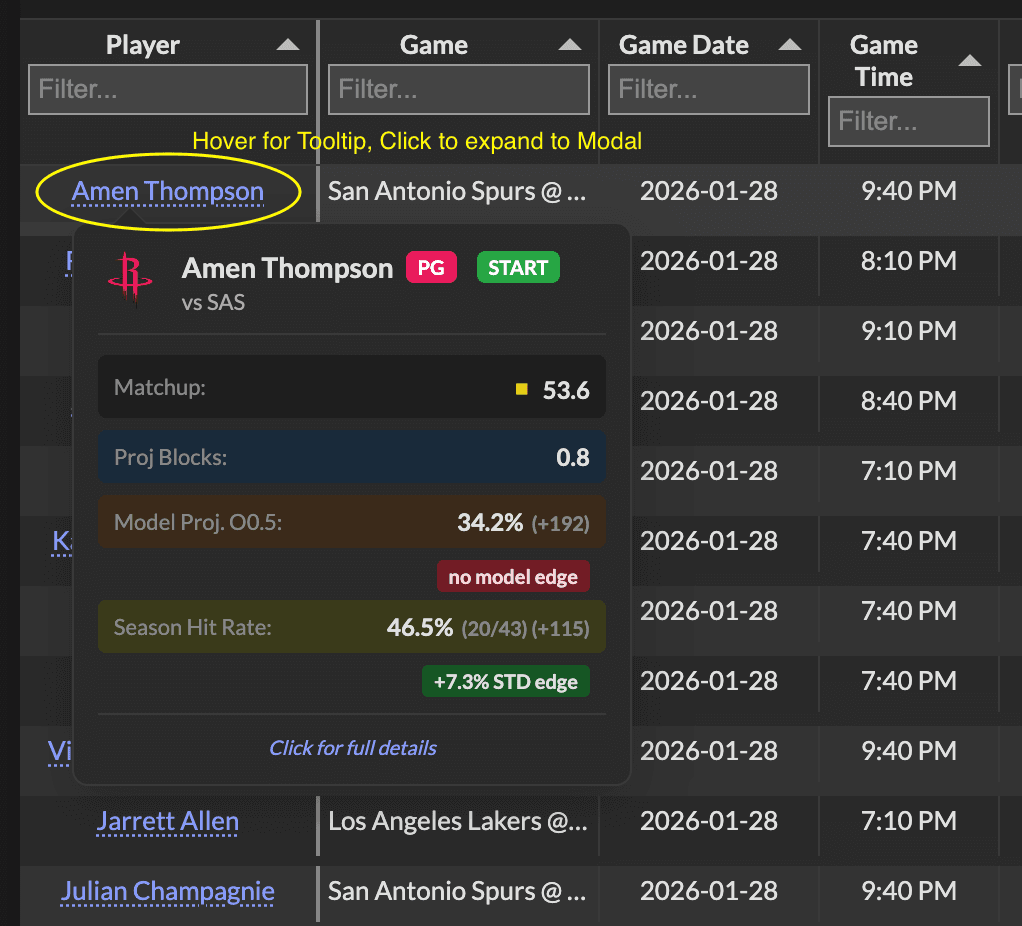
Quick Player Tooltips (Hover/Click)
On Desktop: Hover over any player name to see a quick tooltip with key information.
On Mobile: Tap the player name to open a popup with the same information.
The tooltip shows:
Player Context
-
Team, position, and opponent
-
For NBA: Overall matchup score and Defense vs Position (DvP) rating for the specific stat
-
For NHL: Line assignment (1st line, 2nd line, etc.) and power play unit, plus matchup boost factor
Model Projection
-
Our projected probability for hitting this specific line
-
Shown as both a percentage and American odds
-
Edge indicator: Compares model projection to current best book odds
-
Green badge shows "+X.X% model edge" when the book odds are better than our projection suggests
-
Red badge shows "no model edge" when the book odds don't offer value vs our model
-
🔥 Fire emoji appears for edges of 10% or greater
-
Season-to-Date (STD) Hit Rate
-
Historical hit rate for this player at this specific line
-
Shows games hit out of total games played (e.g., "12/18")
-
Converted to implied odds for easy comparison
-
Edge indicator: Compares historical hit rate to current best book odds
-
Green badge shows "+X.X% STD edge" when book odds are better than history suggests
-
Red badge shows "no STD edge" when the book odds don't offer value vs historical performance
-
🔥 Fire emoji for 10%+ edges
-
Understanding the Edge Indicators
The edge indicators help you quickly see whether the current odds represent value compared to two different benchmarks:
Model Edge tells you: "Based on our projection model, is this bet +EV at the current odds?"
STD Edge tells you: "Based on how often this player has historically hit this line, is this bet +EV at the current odds?"
When both show positive edge, that's a strong signal - the model AND history agree there's value. When they disagree, use your judgment about which you trust more for that specific situation.
Important: These edge calculations are independent of the Fair Value shown in the main table. Fair Value is based on sharp book consensus (market-derived). The tooltip edges are based on our proprietary projections and historical data. They're complementary views, not duplicates.
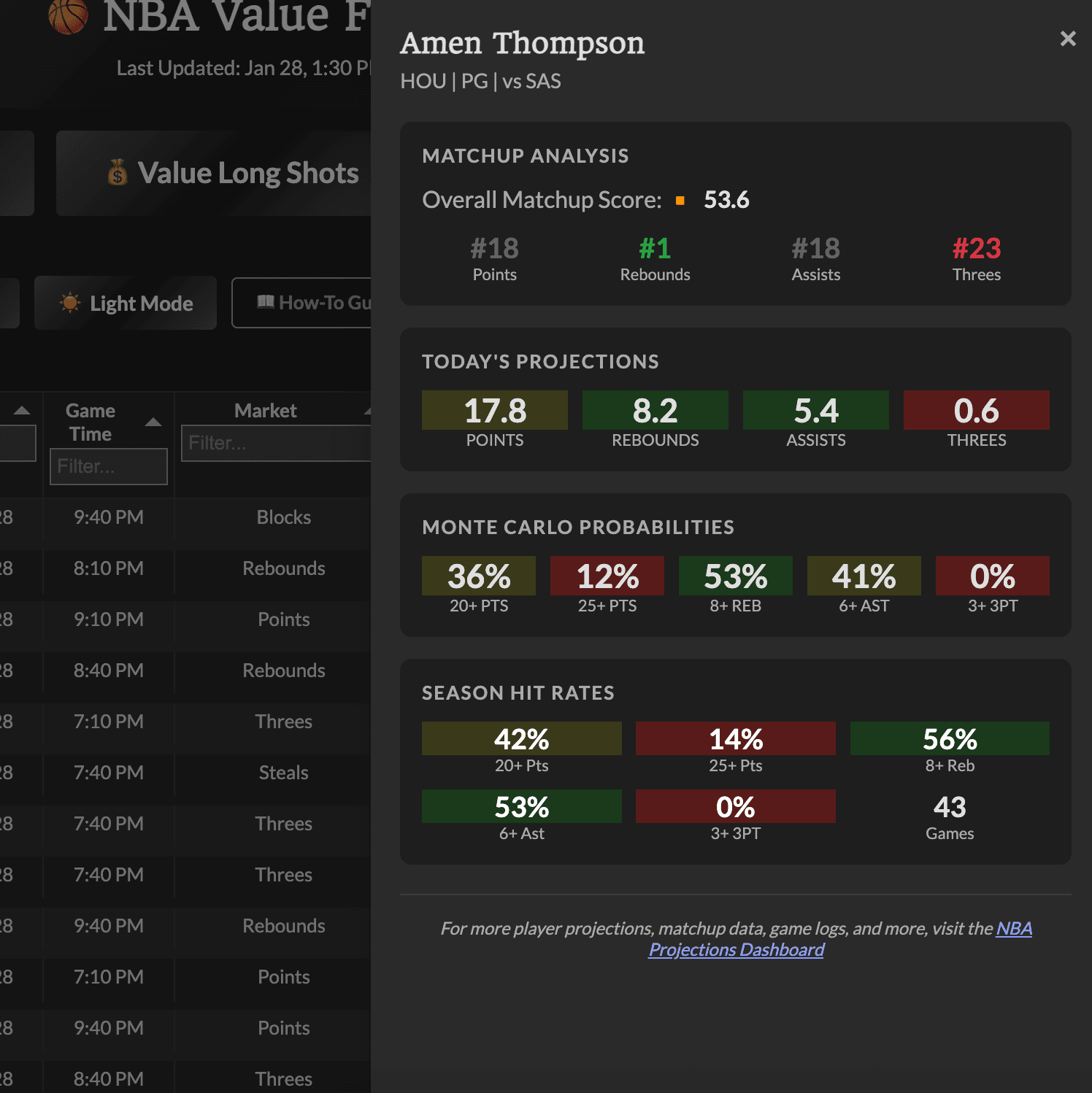
Full Player Details Modal (Click/Tap)
Want even more detail? Click the player name (desktop) or tap "View Full Player Details" in the mobile tooltip to open the full Player Details Panel.
The panel includes everything from the tooltip plus:
Detailed Projections
-
Full stat projections across all categories (points, rebounds, assists, threes for NBA; goals, shots, points for NHL)
-
Color-coded by projection strength
Monte Carlo Probabilities
-
Model-generated probabilities for common thresholds (20+ points, 25+ points, 8+ rebounds, etc.)
-
Helps you evaluate alternate lines beyond what's shown in the main table
Complete Hit Rate History
-
Season hit rates for multiple threshold levels
-
See patterns like "hits 20+ points 75% of the time but only hits 25+ points 40% of the time"
DvP Breakdown (NBA)
-
Defense vs Position rankings for each stat category
-
See if the matchup favors scoring, rebounding, assists, or threes
How to Use Player Data in Your Process
The player tooltips and panel are contextual tools, not primary decision drivers. Here's how to use them effectively:
-
Start with the value math - The main table columns (EV%, Confidence Recc. U, Fair Odds) should drive your decisions
-
Use tooltips for quick validation - A quick hover can confirm whether model and history support the opportunity
-
Dig deeper when uncertain - If you're on the fence about a bet, the full panel gives you more data points
-
Don't override good math with bad gut feelings - If the numbers say it's +EV but you "don't like" the player, the numbers are probably right
For a deeper dive into how our projection models work and how to interpret them, see [Understanding Our Player Projections] (coming soon).
Line Tooltip - Available Lines Breakdown
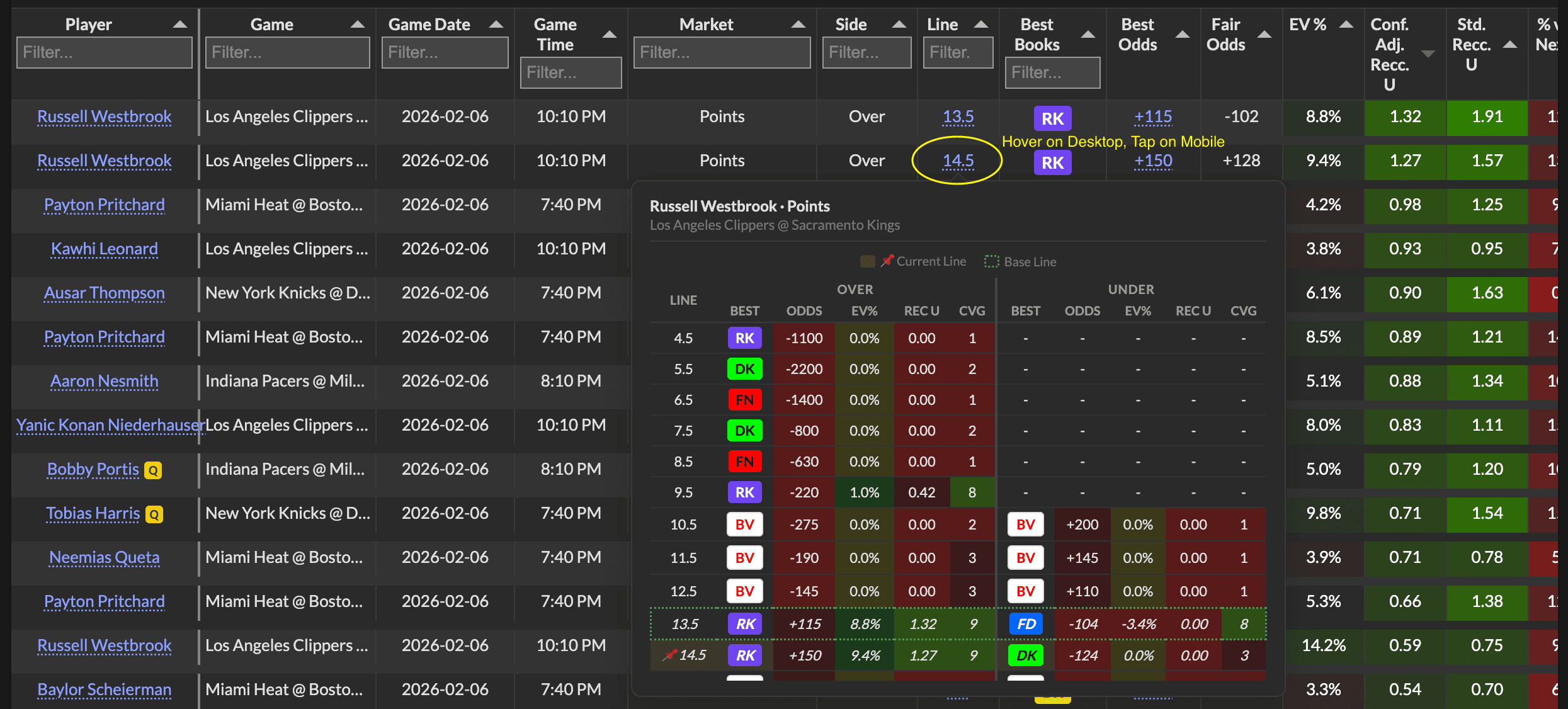
Ever wonder what other lines are available for a player prop you're looking at? The Line Tooltip lets you see all available lines for that player/market in one place, so you can compare and decide if the line you're viewing is the best one to bet.
How to Access
On Desktop: Hover over any value in the Line column (shown with a dotted underline). A tooltip will appear below the cell.
On Mobile: Tap any Line value to open a full-screen popup with the same information.
What You'll See
The tooltip shows a side-by-side table with Over and Under columns for every available line. For each line and side, you'll see:
-
Best - The book offering the best odds for that line/side
-
Odds - The best available American odds
-
EV% - Expected value percentage at those odds
-
Rec U - Confidence-adjusted recommended units
-
Cvg - How many books are offering that line
All data columns are heatmapped (green = higher, red = lower) so you can quickly spot where the value is. The heatmapping on Odds is anchored at -100/+100 (even money) and EV% is anchored at 0%, so the colors are always meaningful regardless of what lines are available.
Current Line vs Base Line
Two indicators help you orient yourself in the table:
-
📌 Current Line - A pin emoji and yellow highlight marks the line and side you hovered/tapped from. This is your "you are here" marker.
-
Base Line - A dotted green outline marks the most standard line for that market — the one with the most book coverage and the most balanced Over/Under odds. This represents where the market is centered.
Comparing your current line to the base line helps you understand whether you're looking at the primary market line or an alternate. Sometimes alternate lines offer better value — the tooltip helps you see that at a glance.
How to Use This
-
Compare lines - If you see a line with higher EV% or Recc. U than the one you're currently viewing, consider betting that line instead
-
Check both sides - The side-by-side layout lets you instantly see if the Over or Under has more value at each line
-
Look at coverage - Lines with higher coverage (Cvg) have more reliable fair value calculations
-
Find the base line - The dotted green outline shows you where the market is centered, which is useful context for understanding alternate lines
Desktop vs Mobile
The Value Finder works on both desktop and mobile, but the experience is a bit different. Here's what to expect on each.
Desktop View
On desktop, you see the full table with all columns visible. You can:
-
Scroll horizontally to see all columns (individual book odds are on the right)
-
Click column headers to sort
-
Type in the filter row below headers to filter
-
Use pre-made filter buttons at the top
This is the power-user view. You have everything at your fingertips and can quickly compare opportunities.
Mobile View
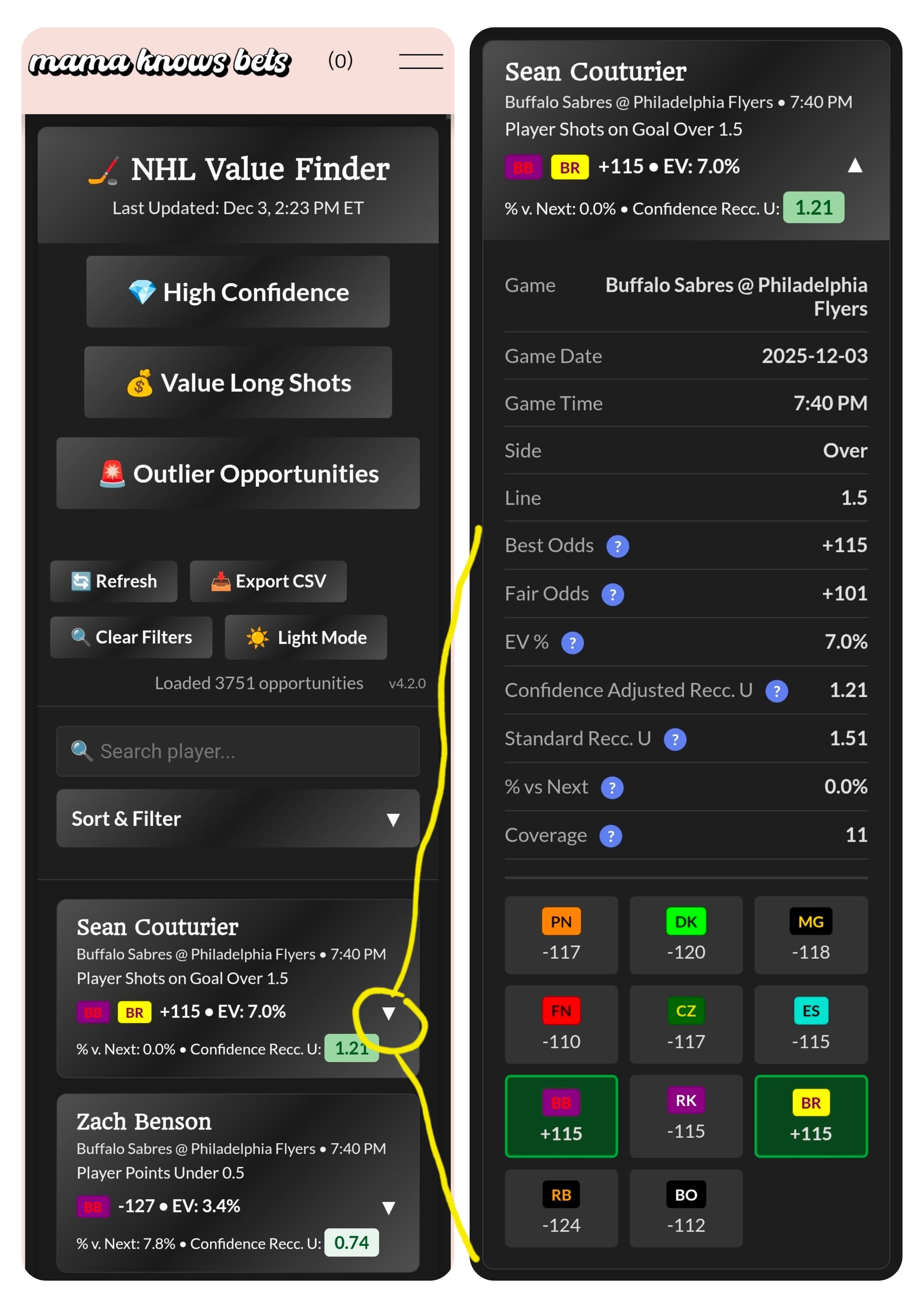
On mobile, the layout adapts to fit your screen. Key differences:
Card Layout: Instead of a table, each opportunity displays as a card with the key information stacked vertically. This makes it easier to read without horizontal scrolling.
Collapsed View: Each card shows the essentials at a glance:
-
Player name, game & game time
-
Market and line
-
Best Book and Best Odds
-
EV % and Confidence Recc. U
-
% vs. Next
Expand for Details: Tap the triangle/arrow on any card to expand it. The expanded view shows:
-
All individual book odds (PN, FD, DK, MG, etc.)
-
Additional details like Coverage, Fair Odds, Standard Recc. U
-
Everything you'd see in the desktop table view
This keeps the mobile view clean while still giving you access to all the data when you need it.
Search Bar: At the top, there's a search bar to quickly find a player by name.
Filter Dropdowns: Tap the "Filters" toggle to expand filter options. You'll see dropdown menus for:
-
Sort By (Confidence Recc U, % vs. Next, Best Book Odds, etc.)
-
Filter by Market
-
Filter by Best Book
-
Filter by Game/Tournament
You can check multiple options in each filter (multi-select), just like on desktop.
Tips for Mobile Users
-
Use the search bar - Fastest way to find a specific player
-
Sort first, then filter - Get opportunities ordered by value, then narrow down
-
Bookmark the page - Add it to your home screen for quick access
-
Cross-reference with the book's app - Have your sportsbook app open to quickly check if the odds are still available
When to Use Which
-
Desktop: Best for deep analysis, comparing multiple opportunities, checking individual book columns
-
Mobile: Best for quick checks, placing bets on the go, monitoring opportunities throughout the day
Both give you the same data - just presented differently for the screen size.
Executing Bets from the Value Finder
This section is critical. The opportunities you see are +EV at the odds shown, at the book shown, at the time shown. For more on this topic, read our Blog post on Why Taking the Best Odds Matters.
Scenario 1: The odds are still available
You see an opportunity: Player X Over 0.5 Goals at +360 on DraftKings, 1u recommendation. Fair odds are +300 (25% implied probability).
You check DraftKings - It's still +360. Take the bet exactly as shown.
Scenario 2: The odds have moved against you slightly
Same opportunity, but now DraftKings shows +340 instead of +360.
The EV is lower. The correct play is to recalculate your stake. A +340 line has less edge than +360, so you should bet less - 0.75u instead of 1u. Use an odds/kelly calculator to determine the exact proper new stake (one will be coming to MKB soon!)
If you don't want to do the math, a simple rule: reduce your stake by roughly the same percentage the odds dropped.
Scenario 3: The odds have moved significantly
The Value Finder showed +360, but now it's +280. At Fair Odds of +300, this is now BELOW fair odds.
Don't take the bet. The edge is gone. You're in -EV territory now. Move on to the next opportunity.
Scenario 4: You can only get it at a different book
The Value Finder shows +360 on DraftKings, but you don't have a DraftKings account. Your best option is +320 on FanDuel.
This could be a trap. You found the opportunity, you want to bet it, but +320 might be -EV even though +360 was +EV.
Make sure it's still +EV at your odds. If the fair value is +300 and you're getting +320, you still have a small edge - recalculate your stake and you can still take the bet. BUT, if the fair value was +340 and you're getting +320, you're now -EV. Pass on it.
If you're new to +EV betting, here's what you need to know.
What is +EV?
Expected Value (EV) is the average profit or loss you'd expect from a bet over many repetitions.
-
+EV (Positive EV): Long-term profitable. The odds are in your favor.
-
-EV (Negative EV): Long-term losing. The house edge is against you.
Why +EV Works
Sportsbooks set lines to balance their action and build in profit margin (vig). But they're not perfect. Sometimes a book offers odds that are actually better than the true probability - that's +EV.
Over hundreds of bets, +EV compounds. Individual bets will win and lose, but mathematically, you'll come out ahead.
*Read even MORE in our post on *What is +EV Betting?
The Kelly Criterion
The Confidence Recc. U and Standard Recc. U columns use the Kelly Criterion - a formula that calculates optimal bet sizing based on your edge and the odds.
Kelly protects you from:
-
Overbetting when your edge is small
-
Underbetting when your edge is large
-
Going broke from variance
We use Quarter Kelly (Kelly × 25 where 1 unit = 1% of bankroll) for more conservative sizing.
For more about setting and managing your bankroll to determine what your unit should be and therefore how much to wager per bet, please read our Bankroll Basics article!
Variance is Real
Even with +EV bets, you'll have losing streaks. That's normal. The math plays out over hundreds and thousands of bets, not dozens.
Trust the process. Stick to the sizing recommendations. Don't chase losses.
This section gets into the methodology behind the numbers. Understanding how Fair Value is calculated helps you interpret opportunities more intelligently and builds confidence in the process.
The Core Concept: De-vigging
Every sportsbook builds profit margin (vig or juice) into their odds. When you see -110 on both sides of a bet, the book is taking about 4.5% off the top. That vig needs to be stripped out to find the "true" probability.
De-vigging is the process of removing the sportsbook's margin to reveal fair odds.
Example:
-
A book offers Over 24.5 points at -115 and Under 24.5 at -105
-
The implied probabilities are 53.5% and 51.2% - totaling 104.7%
-
That extra 4.7% is the vig
-
De-vigging normalizes these to sum to 100%: ~51.1% Over, ~48.9% Under
-
Fair odds would be approximately -105 Over, +105 Under
How We De-vig: The Method Matters
We use individual book de-vigging - each book's odds are de-vigged independently, then combined into a weighted consensus. This is important because:
-
Prevents double-counting vig - If we averaged odds first, then de-vigged, we'd get distorted results
-
Preserves book-specific pricing signals - Each book's de-vigged probability reflects their true market view
-
Allows proper weighting - We can weight sharper books more heavily after de-vigging
For two-way markets (Over/Under), we use proportional de-vigging - both sides are normalized to sum to 100%.
For one-way markets (like Anytime Goal Scorer where we only see one side), we use a sliding vig scale where we remove less vig from shorter odds and more from longer odds. The sliding scale reflects reality - books typically charge more vig on longshots.
Book Weights: Not All Books Are Created Equal
Here's where it gets interesting: we don't weight all books equally when calculating Fair Value.
Some books are "sharper" than others. Sharp books:
-
Take large bets from professional bettors
-
Adjust their lines quickly based on betting action
-
Have more accurate lines because they'd get crushed otherwise
Retail books (the ones you can actually bet at easily) sometimes have "soft" lines that lag behind the sharp market. When a retail book is offering significantly better odds than the sharp consensus, that's often a +EV opportunity.
How book weights work:
-
Each book gets a weight based on how "sharp" we believe their pricing is
-
When calculating Fair Value, sharper books influence the number more heavily
-
If a book isn't offering odds on a market, their weight is redistributed to the books that are
Example: If Book A (sharp, 25% weight) shows 30% probability and Book B (soft, 10% weight) shows 35% probability:
-
The weighted fair value will lean closer to 30% because Book A is weighted more heavily
-
If Book B is offering odds that imply 35% but fair value is 30%, that's +EV at Book B
Market-Specific Book Weights
A book might be sharp in one market and soft in another. For example:
-
A book could be excellent at pricing Points props but poor at Rebounds
-
Another might nail Three-Pointers but struggle with combo markets like PRA
That's why we use market-specific weights - the same book can have different influence depending on which prop type you're looking at.
The Coverage Factor
Fair Value is only as good as the data behind it. When more books are reporting odds:
-
We have more data points to triangulate
-
The consensus is more reliable
-
We're more confident in the Fair Value calculation
When only 2-3 books are reporting:
-
Fair Value might be less accurate
-
One book's error has outsized influence
-
We reduce confidence (which is why Confidence Recc. U scales down)
This is why the Coverage column matters. Higher coverage = more confident Fair Value.
How Profitability Results Refine the Model
Here's something important: we don't just set book weights and forget them. We use actual profitability results to continuously refine our methodology.
The Results Dashboard tracks every opportunity that appears on the Value Finder. When games finish, we calculate whether bets hit or missed and compute P/L. Over time, patterns emerge:
Sharp books get MORE weight if:
-
We're losing when they have the best odds (their lines are more accurate than we thought)
-
Their pricing consistently predicts outcomes better than the consensus
Soft books get LESS weight (or stay the same)
-
We're winning when they have the best odds (their lines are exploitable)
-
They're consistently mispricing relative to the market
The feedback loop:
-
Book weights determine Fair Value →
-
Fair Value identifies +EV opportunities →
-
Results show which opportunities actually profit →
-
Results inform weight adjustments →
-
Repeat
This is why Results Dashboard analysis matters. A book showing strong positive ROI means their lines are soft - we're profiting by fading their prices. A book showing negative ROI means their lines are sharper than we credited - we should weight them more heavily in Fair Value.
We only make weight adjustments when:
-
Sample size is sufficient (100+ bets minimum for a book/market combo)
-
The pattern is consistent, not just a hot or cold streak
-
The signal is statistically meaningful, not noise
Why This Matters for You
Understanding the methodology helps you:
-
Interpret Coverage correctly - Low coverage doesn't mean "bad bet," it means "less confident Fair Value." Size accordingly.
-
Understand why Confidence Recc. U varies - It's not arbitrary. It reflects how confident we are in the underlying calculation.
-
Trust the process - The system is self-correcting. When patterns emerge in results, weights adjust to capture them.
-
Apply your own judgment - If you see an opportunity but only one unfamiliar book is offering the odds, that's context. The Value Finder shows you the math; you decide whether to act.
-
Know this is one approach - Sharp book consensus is a proven methodology, but it's not the only valid approach. Some successful bettors build their own models, some use other tools. The Value Finders give you one well-reasoned framework.
Finding Your "Special Sauce"
Here's the most important thing I can tell you:
There is no one right way to use the Value Finder. Everyone develops their own special sauce.
The Confidence Recc. U is the gold standard to point you in the right direction. After that, you can layer on your own criteria:
Ways to Further Filter Opportunities
-
Focus on one book: Filter to only see opportunities at books you have
-
Focus on one market: Become an expert in goal scorers, or points, or TDs
-
Compare to Pinnacle: Look for large spreads between your book and the sharpest book
-
High coverage only: Only take bets where most books are reporting
-
Time-based: Focus on games starting soon, or get an early jump on lines for tomorrow’s games
-
Player matchups: Use the Value Finder to identify candidates, then apply your own matchup analysis
Combining Value + Data
Some people use the Value Finder purely on the math for value. Others combine it with their own research on players.
My personal opinion: +EV > data, because books have access to all the same data we do - it's already baked into their lines.
But it can be fun and reassuring to review player stats, look at matchups, and make your own assessment. If you have several +EV plays you're deciding between, your own analysis can help narrow it down.
The Learning Curve
You'll learn as you go. You start to notice patterns:
-
What markets move fastest
-
Which books consistently have outlier odds
-
What coverage level feels reliable
-
What works best for YOU
Keep experimenting and exploring to find a style that fits you.
Mama’s Personal Process (Example)
Here's how I personally use the Value Finders - not as a prescription, but as one example of a "special sauce":
-
Sort (high to low) and/or Filter by Confidence Recc. U - this is always my starting point, and I focus on props with >0.25 Confidence Recc. U, however for super long shot props (+2500 and up) ~0.10u is acceptable to me as those will naturally have lower recommendations
-
Filter by book for whichever book(s) I'm placing bets on
-
Focus on my odds/props - I prefer longer odds props (+500 and up) like Anytime Goalscorer, First Basket, Home Runs, etc, for most of my plays
-
Look for high coverage - I prefer 7+ books reporting
-
Check width to sharp books - I look for large spreads between my book and books I consider sharp, like Pinnacle or FanDuel depending on the market
-
If deciding between similar plays in the same game, I'll look at other data indicators to pick one
-
Execute at the shown odds or recalculate if odds have moved
That's my process. Yours might be completely different - and that's great! The Value Finder gives you the foundation; you build on top of it.
Quick Reference
Column Priority (What Matters Most)
-
Confidence Recc. U - Your primary sorting metric
-
Best Book / Best Odds - Where to place the bet
-
Fair Odds - For verifying EV if odds change
-
Coverage - Confidence in the calculation
-
% vs Next - How much of an outlier the Best Book is compared to the next closest book
When to Take a Bet
✅ Odds match or are better than shown
✅ You've recalculated for slightly worse odds
✅ Still +EV at your available odds
When to Skip
❌ Odds have moved significantly against you
❌ Only available at -EV odds
❌ Low coverage and you're uncertain about Fair Value
Best Practices
A few habits that will help you get the most out of the Value Finders:
Hard Refresh Regularly
Do a hard refresh (Cmd+Shift+R on Mac, Ctrl+Shift+R on Windows) every so often to make sure you're running the latest version of the Value Finder. I push updates and improvements regularly, and a cached version might not have the newest features or bug fixes.
Good times to hard refresh:
-
First thing when you open the Value Finder for the day
-
If something looks off or isn't working as expected
-
After I announce an update in Discord
Check Odds Before Betting
The Value Finder shows you a snapshot in time. Odds move constantly. Always verify the odds are still available at your book before placing a bet. If they've moved, recalculate whether it's still worth taking.
Give It the Eyeball Test
Always use discretion and scan the individual book columns before taking a bet. The Value Finder calculates fair value based on all the odds it sees - but sometimes those odds include pricing errors or glitches.
Here's a real example of what can go wrong:
A player's anytime goal scorer odds were showing +575 at most books. But FanDuel briefly glitched and showed +180 for the same player. The Value Finder saw that +180 and factored it into the fair value calculation, making the +575 look like an incredible edge - a "hammer" opportunity.
Then FanDuel corrected back to +575 like everyone else. The fair value adjusted, and suddenly that "hammer" was just a normal line with no special edge.
How to protect yourself:
-
Scan all the book columns - Do the odds look roughly consistent? Or is one book wildly different from everyone else?
-
If one book is a huge outlier, ask why - Is it a legitimate mispricing you can exploit? Or does it look like an error that will correct?
-
Be especially skeptical of outliers that pull fair value in their direction - If the "edge" only exists because of one weird line, it might not be real.
-
When in doubt, wait - Refresh the Value Finder in a few minutes. If it was a glitch, it'll correct. If it was real value, you might still catch it.
The Value Finder is a tool, not an oracle. It shows you the math based on available data - but you need to apply judgment about whether that data makes sense.
And if you miss something and realize later you took bait on a glitchy line? Don't beat yourself up. It happens to everyone. Learn from it, move on, and keep churning.
Don't Chase Every Opportunity
You don't need to bet everything that shows up. Focus on the opportunities that fit your criteria - your books, your preferred markets, your comfort level with coverage. Quality over quantity.
Keep Your Own Records
Track your bets, what odds you actually got, and your results. This helps you understand your own patterns and see how the math is playing out over time. A dedicated bet tracking app is great for this.
Remember:
The Value Finder is a tool. How you use it is up to you. Experiment, track your results, and find what works for your style.
Good luck, and remember: the math is on your side. Trust the process!
——
See Also:How to Use the Value Finders Results Dashboard for how to view and interpret results from the Value Finders!*
——
⚠️ The Value Finders are for entertainment purposes only and are not financial advice. This is gambling, and nothing is guaranteed. Wager at your own risk & discretion. ⚠️
Finding value matters.
Unlock our full suite of tools and join a community of sharp bettors.
- All Value Finders
- Projection models & sims
- Full Discord access
- MLB, NFL, NHL, WNBA, Golf & Soccer (NBA this fall)
- Data export
$35/month — 14-day money-back guarantee
Join MKB VIP