

Bankroll Basics: Why Money Management Matters
December 5, 2025
Part of the Mama Knows Bets Education Series. See also: What is +EV Betting?, Why Taking the Best Odds Matters, How to Use the Value Finders, and [The Seven Deadly Sins of Betting - COMING SOON!].
Why Bankroll Management Matters
Here's the truth that most bettors learn the hard way: you can find +EV bets all day long, but without proper bankroll management, you'll still go broke.
Finding value is only half the equation. The other half - the half that determines whether you're still betting six months from now - is how you manage your money.
I've seen sharp bettors with great analysis blow through their bankroll in weeks because they sized their bets wrong. I've also seen patient, disciplined bettors with modest edge build real, sustainable profits over time.
The difference? Bankroll management.
What is a Bankroll?
Let's start with the basics.
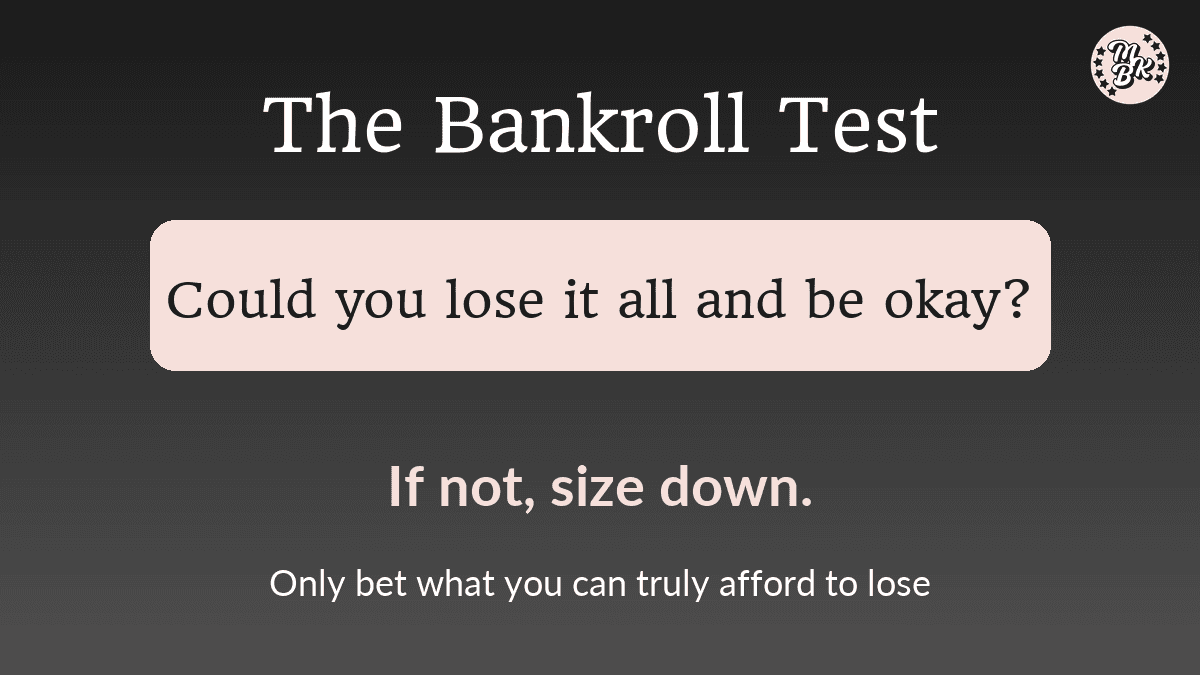
Your bankroll is the total amount of money you have set aside specifically for betting.
This is money you could light on fire today and it would not impact your life. You're okay losing it. It is NOT:
-
Money you need for rent
-
Money you need for bills
-
Money you're hoping to use for something else
-
Money that would stress you out to lose
Rule #1: Only bet what you can afford to lose.
Assume you will lose every play you place, and make sure you can live with that possibility. If losing your bankroll would cause you financial stress or hardship, your bankroll is too big. Reduce it until you can genuinely afford to lose it.
This isn't pessimism - it's protection. Betting with money you need creates emotional decision-making, which leads to chasing losses, oversizing bets, and ultimately losing more.
What is a Unit?
Once you have your bankroll, you need to determine your unit size.
One Unit = 1% of your bankroll. This is the standard bet sizing that allows you to:
-
Weather losing streaks without going broke
-
Take advantage of +EV opportunities consistently
-
Scale up naturally as your bankroll grows
-
Stay in the game long enough for the math to work
Example:
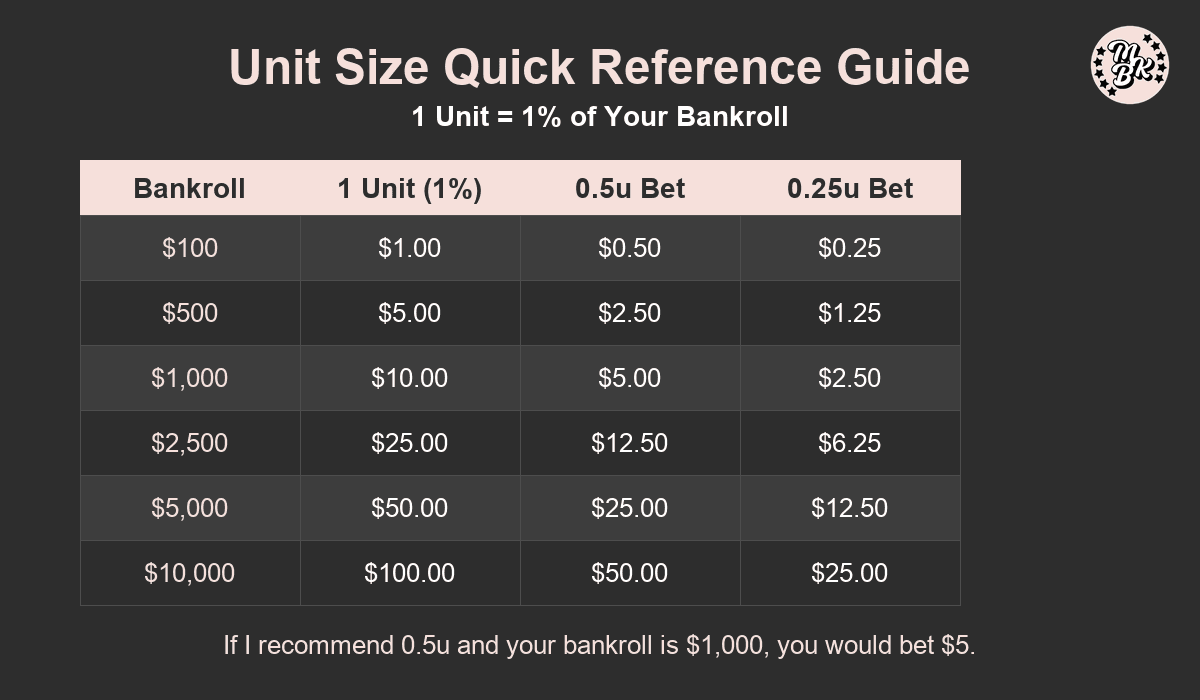
If I recommend 0.5u and your bankroll is $1,000, you would bet $5.
Starting Small is Okay
Don't get intimidated thinking you need a huge bankroll to start. You can start with any size bankroll - what matters is that you're consistent with your unit sizing.
Even $50 (a $0.50 unit) or $100 (a $1 unit) is a perfectly fine starting point. The key is:
-
Pick a bankroll amount you're comfortable with
-
Commit to that amount
-
Always use your appropriate unit size (1%)
-
Only take +EV opportunities
With a smaller bankroll starting out, I'd recommend ONLY taking +EV straights and skipping parlays entirely. Units on parlays should be so small (like 0.1u) that with a small bankroll they won't make sense anyway - a 0.1u bet on a $50 bankroll would be $0.05, and most books won't even let you place that.
Build the bankroll first. Parlays can come later.
"I Don't Have a Bankroll - Where Do I Start?"
This is a question I get often, and it's a really important one.
Here's my honest advice: If you don't have a bankroll, don't gamble yet.
There's no such thing as "easy bets" to build up your account. Nothing is guaranteed. Without:
-
A proper bankroll (money set aside you can afford to lose)
-
A proper unit size (1% of that bankroll)
-
+EV betting discipline (only taking bets with positive expected value)
...you're at risk of mis-sizing bets and continually losing whatever money you're trying to play with.
My recommendation: Stop gambling and start setting aside savings from non-gambling income until you can reach at least $50-$100 as your fresh bankroll. Then start again with proper sizing and discipline.
I know this isn't the exciting answer, but it's the truthful one. This foundation is what separates bettors who build profits over time from bettors who keep reloading.
Managing Your Bankroll Across Books
Once you're betting regularly, you'll need to think about how your bankroll is distributed across sportsbooks.
A few things I've learned:
You don't need your full bankroll deposited everywhere. I typically have maybe 50% of my total bankroll actively deposited across my books at any given time. The rest stays liquid and ready to move.
Keep it fluid. Certain books will run hot or cold - you'll find good edges at some books more than others. You'll need to withdraw and deposit to spread your bankroll around based on where the opportunities are.
Observe where you need more capital. Over time, you'll notice which books you're using most often and need more funds at, and which books you rarely use where you can keep less. Adjust accordingly.
Don't let money sit stale. If a book has too high a balance and you're not using it, move some of that capital to where it's actually working for you.
The goal is to always have your bankroll properly funded where you need it, without having excess sitting idle.
When to Increase Your Bankroll (and Unit Size)
This is a great question I get often, and there's no perfect science to it.
Here's my personal strategy: Small, gradual increases that don't utilize your entire "real" new bankroll.
Example:
Let's say you started with a $2,000 bankroll ($20 unit) and you've been doing well. Now you have $4,000, which would be a $40 unit.
Instead of jumping from $20 → $40, I might actually go to $30 for a period of time. Slowly scale up and settle into it. If you can maintain that $4,000+ for another stretch, then make the next jump to $40.
Why this approach?
-
It protects against variance. I always experience the "unit increase curse" - as soon as I increase my unit, I go on a cold streak for a few weeks. Not utilizing my entire bankroll minimizes the pain.
-
It builds confidence. Gradually increasing lets you get comfortable with the new sizing before going all-in on it.
-
It accounts for positive variance. If you've been running hot, some of that profit might be variance that could correct. Scaling slowly gives you a buffer.
Whatever you do, the key is being thoughtful and not just chasing recent results.
Variance is Real - Never Get Too High or Too Low
This is maybe the most important mindset piece.
We will experience periods of EXTREME positive variance. Weeks that feel like everything is going right. Nights where it seems like we can't lose.
We will also experience periods of negative variance. Stretches where value plays just aren't hitting. Weeks where it feels like nothing is working.
Both are normal. Both are temporary.
Even when plays have value, it doesn't mean they will hit. +EV betting means you're putting yourself in the best possible position to be profitable over time. But "over time" includes the rough patches.
I've been there. I got my butt kicked by MLB almost an entire summer, even though I was betting value lines. Finally at the end of the season I hit my positive variance to make it all back and more. But those dark times are ROUGH!
The discipline that gets you through:
-
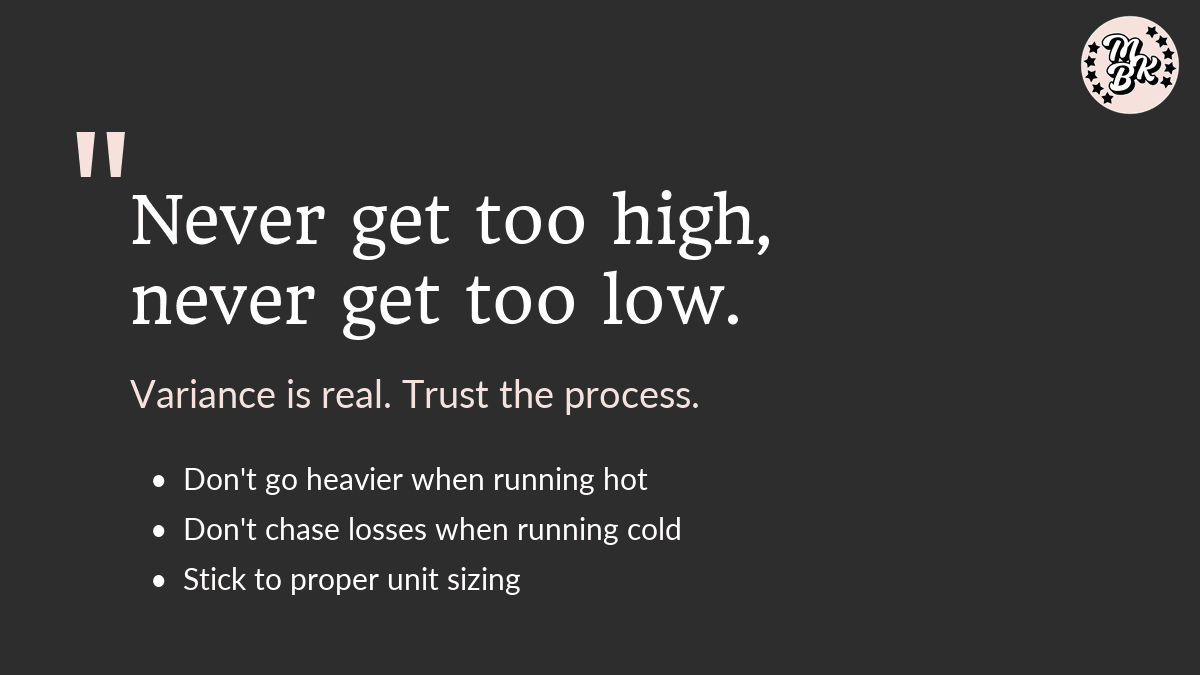
Don't go heavier on units when you're running hot
-
Don't chase losses when you're running cold
-
Stick to your proper units that work for your bankroll
-
Trust the process
When the negative variance storm comes, we'll get through it. And when the positive variance is flowing, enjoy it - but don't let it make you reckless.
Straights vs. Parlays: Where Your Money Should Go
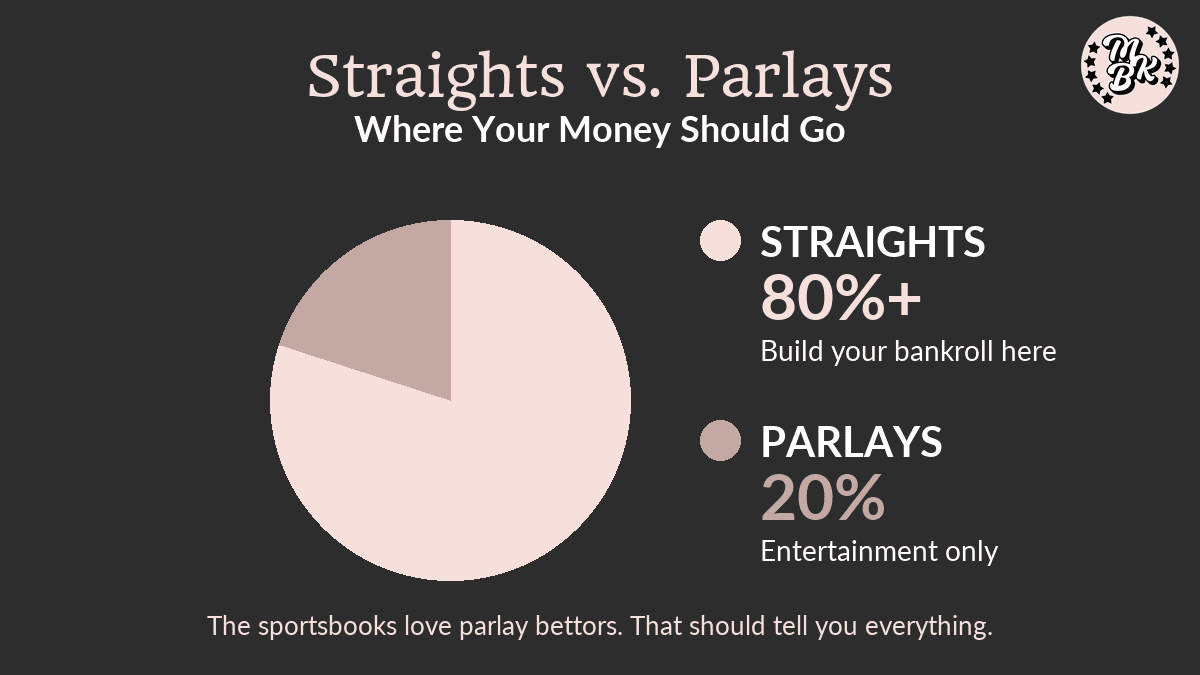
This is a topic I see bettors get wrong constantly. Let me be direct: 80% or more of your daily betting investment should be on straight bets.
Why Straights Should Dominate Your Action
Straight bets are where +EV betting actually works. The math grinds out profit over time because:
-
Lower vig - A straight bet at -110 has ~4.5% house edge. A 5-leg parlay? Roughly 25% house edge. The vig compounds with every leg.
-
More consistent returns - You'll hit a reasonable percentage of straight bets. Parlays? Most of them lose.
-
Better bankroll protection - Straights let you spread risk across many independent bets. Parlays concentrate risk.
The Parlay Trap
I get it. Parlays are exciting. The payouts look incredible. +2500 on a 5-legger sounds way better than five +150 straights.
But here's what actually happens: You find 5 solid +EV opportunities. You parlay them for that juicy +2500 payout. It loses - because parlays almost always lose. Tomorrow you do it again. Same result.
Meanwhile, someone betting those same 5 plays as straights hits 2 of them. A normal day. They're up. You're down.
The sportsbooks LOVE parlay bettors. That should tell you everything.
If You're Going to Parlay: Sizing Rules
Look, I'm not saying never parlay. Just do it right.
The Gold Standard: Use a parlay calculator or Kelly calculator to determine how much the parlay is actually worth based on the fair value of each leg versus what you're getting. This tells you the true +EV (if any) and appropriate sizing. [One will be coming to the MKB site soon!]
The Quick Rule of Thumb: At minimum, your parlay wager should be HALF (or less) of what the legs would be worth as straights.
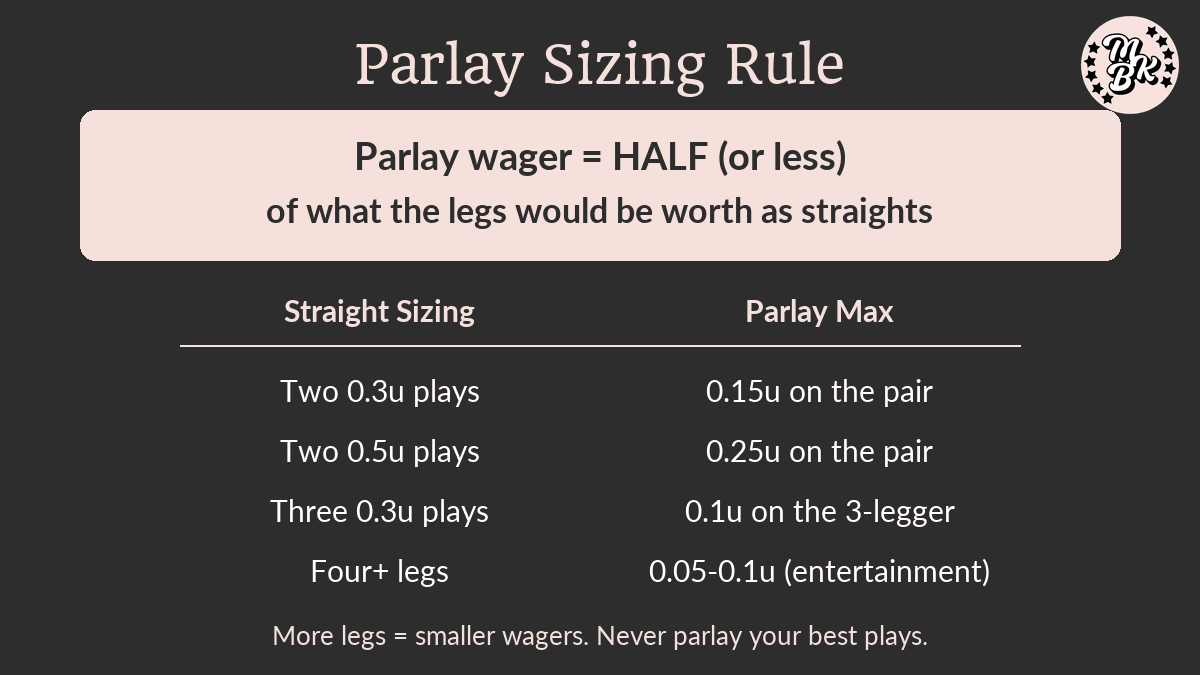
The more legs, the smaller the wager should be. Three legs? Even less than half. Four or more? Treat it like a lottery ticket - entertainment money only.
Never Parlay Your Best Plays
This is critical. Your highest-confidence +EV opportunities deserve full unit sizing as straights. Don't reduce their value by stuffing them inside a parlay.
If you have a strong 0.5u play, bet it as a 0.5u straight. Don't parlay it with other plays and reduce your exposure to that edge.
What About Round Robins?
Round robins follow the same logic as parlays - just applied at each level.
When to consider a round robin: I'd only recommend RRs with higher-odds legs (+300 or higher) that each have significant standalone value - for example, legs where each one has a Confidence Recc. U of 0.25 or more on its own from the MKB Value Finders.
Sizing each level: Each level of the round robin should be HALF (or less) of the prior level:
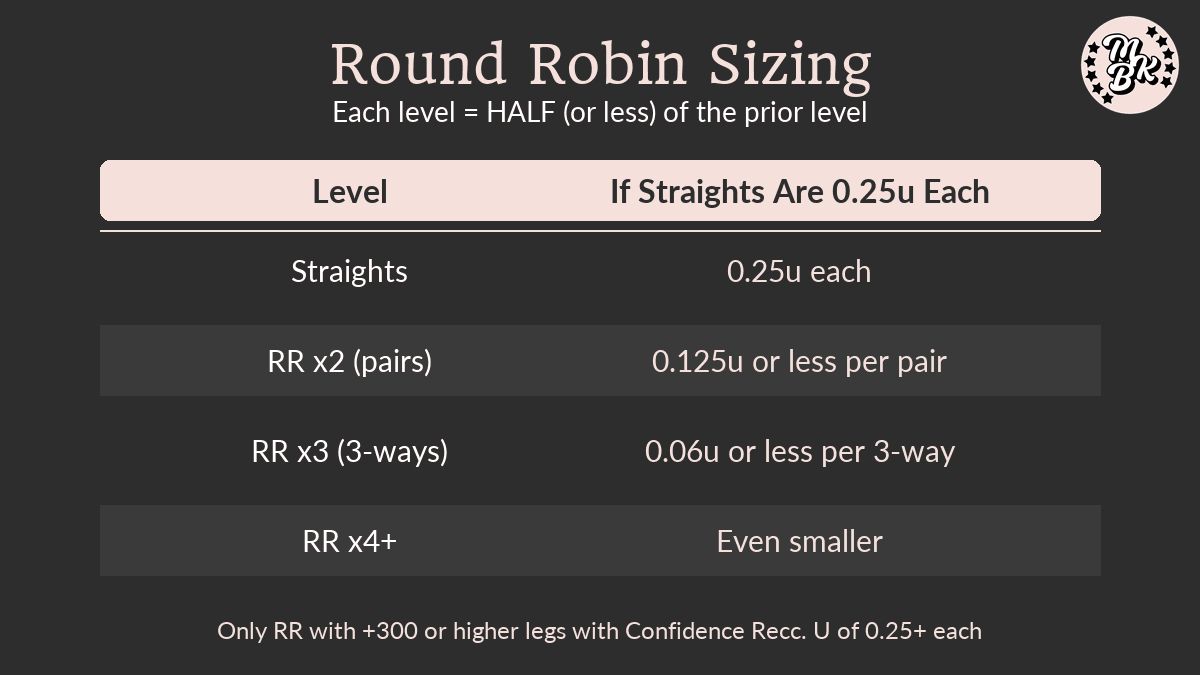
The same principle applies: the more legs you're combining, the smaller each wager should be. RRs give you more ways to win than a straight parlay, but they also require more capital - so sizing down at each level is critical.
Example: You have 4 legs, each 0.25u plays with strong value (+350, +400, +320, +380).
-
Bet each straight at 0.25u = 1u total on straights
-
RR x2 (6 pairs) at 0.1u each = 0.6u total on pairs
-
RR x3 (4 combos) at 0.05u each = 0.2u total on 3-ways
-
Skip the 4-leg parlay or do 0.025u max
Total action: ~1.8u spread across straights and RR levels. You're covered at multiple levels while keeping position sizes appropriate.
The Bottom Line on Parlays and Round Robins
-
80%+ of daily investment → straights
-
Use a calculator to properly size parlays
-
Quick rule: half (or less) of what legs would be worth as straights
-
More legs = smaller wagers
-
Never parlay your best plays
-
RRs: only with high-value, higher-odds legs - size each level at half the prior
Build your bankroll with straights. Treat parlays and RRs as a small side entertainment, properly sized, not your main strategy.
🏫 Mama's Rules of Betting 🏫
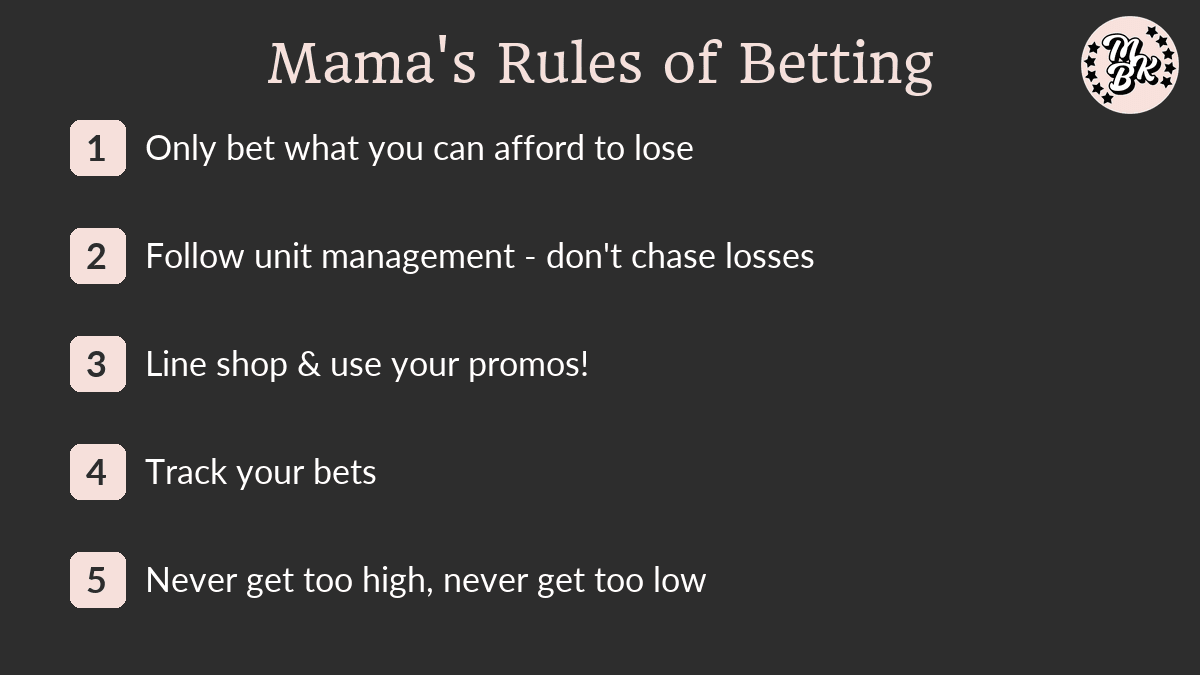
1. Only bet what you can afford to lose 🧘🏻♀️
Assume you will lose every play that you place, and make sure you can live with that possibility.
2. Follow unit management - don't chase losses with larger bet sizing
-
One Unit = 1% of your bankroll
-
Bankroll = total money you have set aside for betting; money you could light on fire today and it would not impact your life. You're okay losing it. NOT money you need ‼️
- For example: if your bankroll is $1000, your unit is $10. If I recommend 0.5u, you would put $5 on that play. 🧮
3. Line shop & use your promos! Always take BEST BOOK ODDS!! 📚
4. Track your bets 📈
(a dedicated bet tracking app or a simple spreadsheet both work well for this)
5. See Rule #1. And try to have fun. Never get too high, never get too low. 🫶🏻
Quick Reference
Setting Your Bankroll
-
Choose an amount you can genuinely afford to lose
-
This money should NOT be needed for anything else
-
Start small if needed - $50-$100 is fine
Calculating Your Unit
-
1 Unit = 1% of bankroll
-
$100 bankroll = $1 unit
-
$1,000 bankroll = $10 unit
-
$5,000 bankroll = $50 unit
Bet Sizing
-
Follow the recommended unit sizing (0.25u, 0.5u, 1u, etc.)
-
Never increase bet size to chase losses
-
Never increase bet size because you're "feeling it"
Increasing Your Bankroll
-
Scale up gradually, not all at once
-
Don't utilize 100% of your new bankroll immediately
-
Give yourself time to adjust to new unit sizes
The Bottom Line
Bankroll management isn't sexy. It's not the exciting part of betting.
But it's the part that keeps you in the game. It's the part that lets the math work. It's the part that turns +EV opportunities into actual, realized profits.
Set your bankroll. Know your unit. Be consistent. Be patient.
The education piece is super important to me. Let me know if you have any questions - I'm always happy to help.
———
Ready to learn more? Check out What is +EV Betting? for the foundation, Why Taking the Best Odds Matters for the importance of always taking the best odds, How to Use the Value Finders for finding opportunities, and [The Seven Deadly Sins of Betting - COMING SOON!] for the mistakes to avoid.
**⚠️ This is not financial advice. This is gambling, and nothing is guaranteed. Wager at your own risk and discretion. ⚠️
Finding value matters.
Unlock our full suite of tools and join a community of sharp bettors.
- All Value Finders
- Projection models & sims
- Full Discord access
- MLB, NFL, NHL, WNBA, Golf & Soccer (NBA this fall)
- Data export
$35/month — 14-day money-back guarantee
Join MKB VIP